Young people are less confident they will have stable jobs or be able to afford their own homes in the future.
Deciding whether to go to university or take an alternative career path is crucial for young people, who will have to weigh high debt levels versus an ultra-competitive market.
Millions of young people will get their A-level results this week, with decisions to make that will impact their financial futures.
Maike Currie, vice president of personal finance at PensionBee, said the results day used to dictate whether someone got the correct grades to go to university. Today, however, the choices are much broader.
“Prime minister Andy Burnham has said he wants vocational and technical education to be placed on a more equal footing with the traditional university route, reflecting a wider push to give young people more options after school,” she said.
The issue with university is the fees involved. Many graduates can leave university with around £50,000 of student debt and could make repayments for up to 40 years as interest rates make it difficult to pay off.
Under Plan 5 – which applies to students who started university from 2023 – repayments begin once earnings exceed £25,000, with 9% of earnings above this threshold paid back.
“For many students, university will remain the right choice. But the financial stakes have risen,” said Currie.
However, she added that the upfront costs are not the only thing to consider. Students should also look at likely earnings, living costs, qualifications, experience and future career prospects.
Apprenticeships are another option. They offer the chance to earn, gain experience and potentially avoid student debt. However, they are “fiercely competitive” and therefore can be difficult to get hold of, while a university can be the only route to certain jobs.
Taking time to make the right decision can be a good idea, but there is a difference between taking time to work out your next move and simply falling out of education and employment, she warned.
Data from the Office for National Statistics (ONS) found that more than 1 million young people aged 16 to 24 were not in education, employment or training in the first quarter of 2026.
This is at a time when AI is also reshaping entry-level work. While the nascent technology is creating new skills and jobs, it is also restricting opportunities in some areas.
Whether they go to university or enter employment, young people are less confident than previous generations that they will get a stable full-time job or be able to buy their own home, according to Ipsos research.
Currie said: “Gen Z has not stopped aspiring to financial security. Young people still want stable jobs, independence and homes of their own but in a fast-changing world with record youth unemployment, they are increasingly less confident they will achieve them.”
It is a bleak outlook for Gen Z, with data from St. James’s Place finding that younger generations are feeling financial pressures most intensely. More than half of 18- to 34-year-olds (54%) responded to the firm’s survey stating that their financial situation has negatively affected their mental health over the past year.
Building good finance practices early can help, said Currie, who suggested young people learn to budget before they enter the workforce or fly the nest and head to university.
“Financial education is part of the curriculum in secondary schools in England, but not all young people receive the same level of practical preparation for managing their own finances,” she said, suggesting that parents can help their children too by making money a normal part of family conversation.
“Before leaving home, young people should understand the basics: what is coming in, what is going out and where their money is going. For a student, that might mean managing a maintenance loan across a term, while for an apprentice it might mean making that first monthly salary last until payday,” she said.
This can include saving early. Parents can do this by saving into a junior ISA, which is handed over to a child at 16 and makes for a “good opportunity to explain what the money is invested in, why it was saved and the choices available from here”.
Options available include a stocks and shares ISA or a lifetime ISA, which the government plans to replace with a new first-time buyer ISA.
“We cannot remove every financial barrier facing this generation, but we can make sure they understand the choices in front of them and start adult life with the financial skills to make the most of whichever route they choose,” she concluded.
Around one in four respondents said their finances had impacted their physical health.
Some 40% of people have suffered mental-health-related problems caused by their financial situation, a new study by wealth manager St. James’s Place has found.
The firm’s financial health report found that money issues are affecting people’s daily lives, with mood and anxiety about the cost of going out being two of the most common mental-health side effects of money worries.
In the survey of 6,000 people, 38% said their finances had impacted their physical health. Around one in six (17%) said financial pressure had caused increased grey hairs or wrinkles, while 16% said they were forced to buy cheaper, less healthy food which was impacting their weight and sleep.
Alexandra Loydon, group advice director at St. James’s Place, said: “Over the past five years, households have faced successive crises and challenging economic conditions, from higher mortgage costs to rising energy and food bills.”
This has taken a toll on people’s mental and physical health, as well as their financial resilience. Indeed, millions of Britons lack a financial safety net, she noted.
The research found almost two in five people have less than £10,000 in savings, investments and physical possessions. Around 14% of respondents said they had no wealth at all.
One in five (21%) UK adults described themselves as struggling financially, while almost three in 10 said they do not feel financially resilient or able to cope with an unexpected financial shock.
These figures track with research from Scottish Friendly Assurance Society, also released today, which showed that around one in five people do not have a long-term financial goal or plan. This rose to 30% of lower earners but fell as wage bands increased.
Kevin Brown, savings expert at Scottish Friendly, said: “It is concerning that nearly one in five people have no clear idea of what they want their finances to achieve. It is hardly surprising, yet no less concerning, that this rises to almost one in three among those on lower incomes.
“Long-term direction is not only for those with substantial sums to save, since where budgets are tighter, being clear about future priorities can matter even more – even if immediate costs leave little room to act.”
Making a plan is one easy way that people can start to get their finances back on track, according to Loydon. “Our research shows those with a financial plan are more likely to feel financially comfortable and able to cope with financial shocks,” she noted.
The first step is to stop ignoring the reality of the situation. When things get difficult, some may feel inclined to avoid the situation and put off tackling the problem.
“This only makes matters worse, both financially and emotionally, and it’s important to confront your financial worries as soon as you can and make a plan of action,” said Loydon.
“Finances can be a difficult topic to discuss, but people should not feel they have to manage these concerns alone. Seeking support from family and friends, debt advice charities, financial advisers or mental health professionals can provide valuable guidance and reassurance during difficult periods.”
Next is to create a budget. During times of financial stress, it is imperative to check monthly outgoings and avoid unnecessary spending.
“Firstly, make a note of your necessary outgoings such as mortgage repayments and utility bills, accounting for any upcoming price hikes. Next, consider additional expenses, such as recreational activities, and see how much money you can allocate for these activities and where you might be able to reduce spending,” she said.
People should start to build an emergency fund when budgeting, factoring in how much can be set aside each month. Overall, people should aim for around three to six months’ worth of spending – a figure that will differ for each person and can only be calculated based on monthly budgeting.
This offers people protection in the event of a financial emergency and provides a buffer for those in between jobs or facing higher living costs.
“But it’s important to note that emergency savings are designed to offer short-term support, so it is important to review and rebuild the fund after using it,” she said.
The chipmaker's plan to help fund AI infrastructure has raised fresh questions over how much of the sector's growth it is bankrolling itself.
Nvidia has announced plans to help mobilise up to $500bn for new AI infrastructure, working with six financial partners – Apollo, BlackRock, Blackstone, Brookfield, Goldman Sachs and KKR.
Under the plan, these firms will set up funding vehicles that let outside investors put money into the data centres that AI systems run on, in return for a share of the income those data centres generate.
The scale of the plan will have people worried, according to Matt Britzman, senior equity analyst at Hargreaves Lansdown.
“Nvidia’s plan to help mobilise up to $500bn for new AI infrastructure is a powerful sign of its ambition, but it will also sharpen concerns about circular financing,” he said.
The scale of AI spending across the sector, including capex guidance and lease obligations, will fuel debate over whether the industry is investing too much and too quickly particularly as more borrowing enters the financing of new AI infrastructure. But, he said, large long-term commitments do not automatically mean reckless overbuilding and he urged investors to look past the headline figures to the detail behind them.
“Context, timelines and flexibility matter,” he said.
Nvidia may also invest directly alongside its financial partners, covering up to 25% of the cost of any single data centre built under the plan. Here, the important distinction for Britzman is that “Nvidia expects to play a relatively passive role, with independent investors assessing each opportunity on its own merits and providing most of the capital”.
That should offer some reassurance that data centres will face outside scrutiny rather than being built simply to create demand for Nvidia's products.
If the plan succeeds, he added, Nvidia could benefit twice: first from selling the chips that go into the data centres, then through a share of the income the facilities generate. Hargreaves Lansdown continues to see Nvidia as having one of the most attractive risk/reward profiles in the tech sector.
Neil Wilson, investor strategist at Saxo UK, said the financing plan pointed to continued institutional demand for AI infrastructure. US stocks had already pulled back on Monday, with the S&P 500 retreating after closing at a record high on Friday amid tensions between the US and Iran, but for him the Nvidia news added a positive note to an otherwise cautious session.
“It signals plenty of institutional demand still out there for the AI buildout, which is a positive for stocks,” he said.
The plan could also draw funding from investors beyond the small group of hyperscalers that have funded most AI data centres themselves so far, sometimes referred to as the Magnificent Seven.
“It helps secure Nvidia as the dominant infrastructure partner for firms that want to tap AI but don't have the cash on hand like the Mag7 do,” he concluded.
Trustnet's 10-year Japan data confirmed underperformance but experts point to a concentration and dispersion problem, not a Japan problem.
Things might be on the up for Japan, with investors increasingly gaining confidence in the market thanks to slowly improving corporate governance reforms as well as the Bank of Japan stepping away from negative rates. For the first time in years, advisers have reported renewed client interest in Japan.
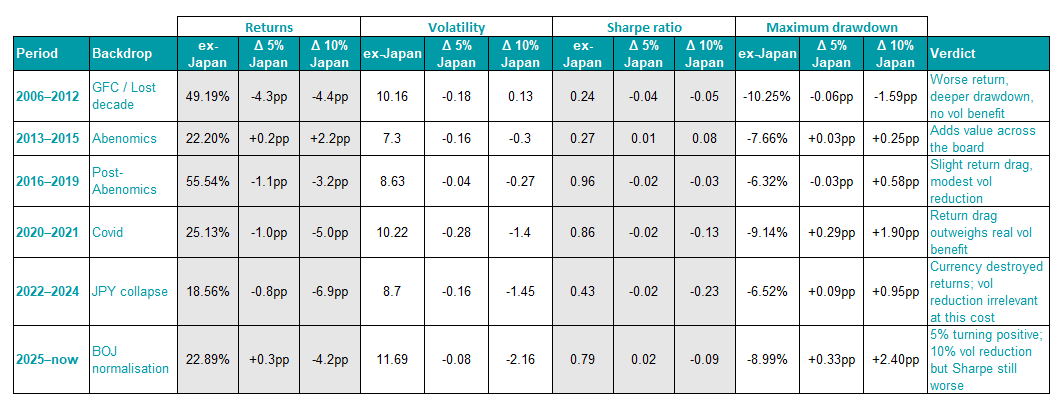
But over the past decade, adding Japan to an investment portfolio hasn’t improved it materially on different metrics, including Sharpe ratio, volatility and maximum drawdown, according to the Trustnet study below.
The exception was during the period known as Abenomics (2013 to 2015), when then-prime minister Shinzo Abe started the reforms that are being further implemented today by incumbent prime minister Sanae Takaichi, who took power in October last year.
In this study, we used a 60/40 global portfolio as a baseline, split between the MSCI ACWI ex Japan index for equities and the Bloomberg Global Aggregate index for bonds. Then we added a 5% and 10% allocation to Japanese equities, which have been carved out of the 60% equity sleeve.
As the Japan proxy, we used the IA Japan sector average, which represents the average fund that the average investor might have chosen to access the market.
For each allocation split, we measured four metrics: cumulative return, which shows the outcome; volatility, which tells how smooth the journey was; Sharpe ratio, which measures return per unit of risk taken and whether Japan's diversification properties actually earned their place in the portfolio or whether they came at too high a cost; and maximum drawdown, which isolates the worst peak-to-trough loss within each period.
Source: Trustnet
What the data shows
Adding Japan to a global portfolio over the past decade did little for returns and only slightly smoothed the ride. A 10% allocation to the IA Japan sector average returned 129% over 10 years, well below the 167.4% delivered by a portfolio that left Japan out altogether. A smaller 5% allocation came closer, at 162.4%, but still lagged.
The shortfall was not spread evenly across the decade. Three periods drove most of it – the aftermath of the financial crisis, the Covid years and the yen's collapse between 2022 and 2024.
While the figures above paint a bleak picture for Japanese equity enthusiasts, Joshua Adler, Japan investment specialist at Orbis, said things look different once dispersion between managers is accounted for.
Japan “has not been a beta market”, he said. Outside of Abenomics, the 2023 Tokyo Stock Exchange reforms and the recent AI rally, middling to poor returns have meant that the market has been rewarding for stock pickers, noting that the Orbis Japan fund has outperformed the MSCI World index on a constant currency basis.
Simon Evan-Cook, multi-manager at Downing, added that the figures above may not be as bad as they first appear, particularly when considering the strong returns of US markets, which now tend to dominate developed equity indices (and even more so with Japan removed).
“I wonder how much of that is down to Japan and how much is down to just how well US equities have performed," he said. “I suspect for almost any country you could find that you'd have been better off not holding any, and all because the global index's biggest component – the US – has produced exceptionally high returns.”
Also, the average fund has suffered relative to the market due to an underweight in mega-caps, Evan-Cook explained, a phenomenon that is “not unique to Japan”.
That said, he still recommended including Japan in portfolio, and in particular, active funds. “The valuation of the market looks fair, while there are plenty of bargains lower down the market-cap scale as investment trends have left them behind,” he said.
Adler added: “Passive exposure to Japan already offers a low correlation building-block within a global portfolio; actively investing within Japan can enhance diversification even further.”
A genuine change is going on across Japanese companies, said Adler. Long associated with lazy balance sheets, piles of idle cash, cosy cross-shareholdings and poor capital allocation, now management teams are being held accountable.
“Active engagement lets us identify and work with companies genuinely committed to improving, potentially accelerating their re-rating rather than waiting for the market to price it in,” he said.
“Passive exposure to Japan already offers a low correlation building-block within a global portfolio; actively investing within Japan can enhance diversification even further.”
The outlook for Japan from here
While the past may not show Japanese equities in the most positive of lights, the more recent data is appealing. Since 2025, including these stocks in a portfolio has provided better returns while also bringing volatility down.
Comparisons may be made to Abenomics, although Adler said there were some key differences, as well as similarities.
For example, the corporate reform that Takaichi inherited is a continuation of Abe’s, but we are now “much further along the line and reformation in Japan has picked up real traction”.
However, Abenomics was part of a plan to escape deflation, including “a program of aggressive easing from the Bank of Japan, with open-ended asset purchases and negative interest rates, deliberately weakening the yen”
More recently, Japan has spent most of the past four years with inflation running above the Bank of Japan’s target. Asa result, today, the Bank is doing the opposite.
This could be a positive, according to Nicola Takada Wood, Japan managing director at Asset Value Investors, who argued today's backdrop was more durable than the early stages of Abenomics.
“While the 2013 rally was driven primarily by aggressive monetary easing, fiscal stimulus and a sharp depreciation of the yen, the current backdrop is underpinned by more durable structural improvements," she said, citing stronger capital allocation, higher dividends and buybacks, and a gradual shift of household savings from cash into equities.
She expected Takaichi to continue or accelerate that momentum and saw the unrealised opportunity sitting in smaller companies, where governance reform remained in its early stages.
Nicolas Tirogalas explains why it could take at least six months once the strait is reopened for trade to return to its full capacity.
Trade through the Middle East will pick up again when the conflict between the US and Iran ends, but it will not be the same as it was before, according to Nicolas Tirogalas, chief executive of Tufton Investment Management and co-manager of the Tufton Assets investment trust.
The Strait of Hormuz remains severely disrupted after the tentative ceasefire between the two sides was abruptly ended at the start of last month, although drafts of a new agreement are being circulated between the parties, according to reports.
However, before the war few would have anticipated that the closure of the strait would be a realistic scenario, said Tirogalas. His Tufton Assets trusts invests in sea-faring transport vessels and has the apt ticker SHIP.
“People assumed there'd be conflict, but not that. Now that they have closed it once, people know for sure they can close it again,” he said.
As a result, countries are now in a rush to find alternative supply sources, as they now understand the tangible risks that come with using the Strait of Hormuz, which will lead to a huge reduction in future activity in the region.
“Maybe trade becomes 60% or 70% of what it used to be,” he said. “Some trade will come back from the region once it fully reopens, but [in our experience] it never returns to exactly how it was before.
“Nothing is going to come back to 100% of what it was – and even if it did, the lag for that repositioning is a minimum of four to six months for renormalisation and rebalancing of ships around the fleet.”
Indeed, at the outbreak of the conflict Tirogalas noted that Asian countries reliant on Middle Eastern oil had to find the commodity from elsewhere, which led to a rise in the demand for ships in and around the US Gulf. This more than doubled the distance, however, compared with ships transporting oil from the Middle East.
Tirogalas said it took a “couple of months” to reposition the entire world fleet, or a large part of it, out of Asian and Middle East waters and into the Atlantic – or to the Pacific rather than the Atlantic. The same will be true of returning vessels back to the Strait of Hormuz when it eventually reopens at the end of the conflict.
As a result, people should expect a minimum of half a year before trade fully resumes (albeit at a likely lower peak than previously), he warned.
This could have a large impact on inflation, which has remained elevated around the world as energy prices have ratcheted higher.
“On inflation, it's very much about the perception of what happens to the price of energy – in this case oil. We saw it [the oil price] jump over $100 last month and now we're back under $100. As soon as everyone thinks there's a risk of conflict, you see the price of petrol or gasoline go up, and it comes back down as the risk eases,” he said.
This makes shipping 'an absolute inflation hedge as an industry', because rising demand for commodities pushes up both prices and the volumes that need to move. With more cargo competing for the same fleet capacity, freight rates climb too, so shipping revenues tend to rise alongside inflation rather than lag behind it.
However, Tufton Assets is not invested in oil tankers. In fact, it is predominantly invested in product tankers and dry bulk ships that move grains and agricultural produce.
“We bought these dry bulk carriers because we estimated mid-teens returns on the investment. So at different points in time, different sectors offer different returns based on our own analysis,” he said.
“Today, dry bulk is very attractive; tankers are very attractive that's why our positioning is weighted towards tankers and dry bulk carriers and less so towards elevated-price sectors.”
Liquified natural gas (LNG) is also attractive, although the manager noted that it costs around $100m per ship, a tall ask for an investment trust with a market capitalisation of $361m.
One area that has gone off the boil is large shipping containers, which were in vogue during and after Covid as the world re-opened and pent-up demand caused backlogs at ports around the world.
“Back in 2021/22, if you owned a container ship, you were going to become a millionaire overnight. Today, you're going to make good money, but not the same millions and billions that a lot of ship owners made back in 2021/22,” he said.
Tufton Assets is 11–12% leveraged on its fleet and aims to pay a dividend yield of between 7% and 8% per year, while its shares trade at a 17% discount to net asset value.
Meanwhile, gold moved from an underweight to a neutral position while government bond exposure increased.
Forvis Mazars has cut equity exposure to UK stocks and mega-cap US technology names while increasing allocations to gilts and gold in the latest rebalance of its model portfolios.
The wealth manager said the move reflected profit-taking after a period of strong equity performance, alongside a continuation of a strategy begun in January to tilt away from the largest US technology companies.
It reduced equity weightings across most of its model portfolios, funded mainly by trimming its global equity index tracker fund and its UK index tracker fund. The Defensive and Equity Risk models, whose mandates cap tactical equity positioning, were not included in this change.
Ben Seager-Scott, chief investment officer at Forvis Mazars, said: "Equity markets have delivered strong returns so far this year, supported by underlying earnings growth. Our portfolios have benefited from maintaining a positive tactical equity stance throughout this period and we are now taking some profits from those positions.
"At the same time, we are continuing the trade initiated at the start of the year by tilting away from mega-cap US technology names and reinvesting across the broader US market, which we believe will be among the principal beneficiaries of AI-enabled productivity gains."
In the firm's Balanced portfolio, this involved trimming iShares Developed World Index from 14% to 12.25% and lowering iShares UK Equity Index from 2.5% to 1.75%.
Within US equities, the firm continued shifting from market-capitalisation-weighted trackers such as State Street SPDR S&P 500 into L&G S&P 500 US Equal Weight Index. This reduced exposure to the so-called Magnificent Seven while keeping the portfolios overweight the US market overall.
In the Balanced model, L&G S&P 500 US Equal Weight Index's allocation rose by 4.25 percentage points, from 3.50% to 7.75%, while the market-capitalisation-weighted tracker was taken from 2.75% to zero.
Forvis Mazars' Cautious, Balanced, Capital Growth and Adventurous models increased allocations to the Baillie Gifford Pacific fund, partly to address a South Korea underweight following a recent pullback in that market. This was funded by reducing its emerging market tracker "to focus more assets into a high conviction fund manager".
Elsewhere, the Cautious and Balanced models switched out of the BlackRock Continental European fund into a tracker fund: iShares Continental European Equity Index. "In these portfolios we prefer broad market exposure to control portfolio risk budgets," Seager-Scott said.
Proceeds from the equity reductions funded two further changes: gold moved from an underweight to a neutral position after a period of weakness and government bond exposure increased. This included higher allocations to US treasury inflation-protected securities and conventional UK gilts.
Forvis Mazars' models remain "marginally overweight" equities, Seager-Scott added.
The rebalance follows a period of strong performance across equity markets. Developed market equities have risen by 13.6% so far this year in sterling terms, with Japan up close to 20% and the other main developed markets gaining between 12% and 13.5%; emerging market returns are also nearing 20% for the year.
Performance of global stocks in 2026
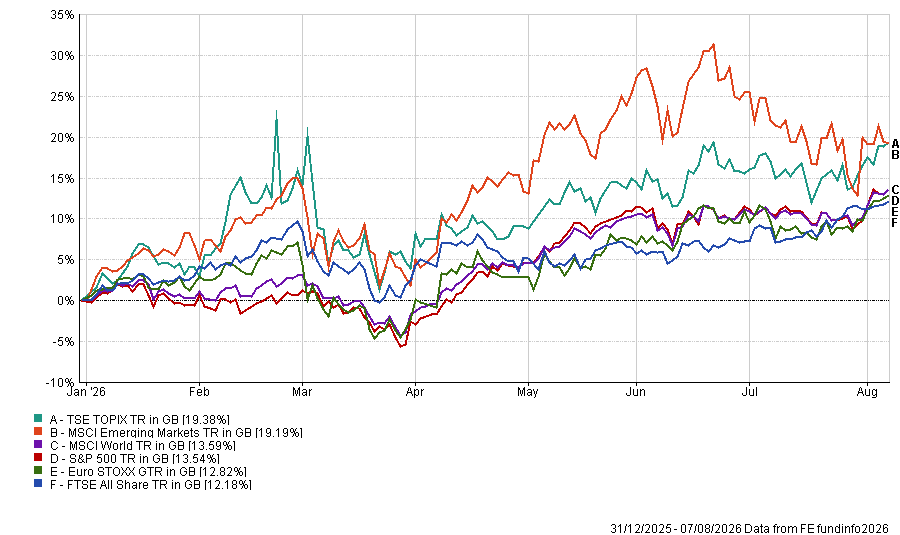
Source: FE Analytics. Total return in sterling between 1 Jan and 7 Aug 2026
As a group, the Magnificent Seven (Alphabet, Amazon, Apple, Meta, Microsoft, Nvidia and Tesla) have underperformed the MSCI World in 2026, having dominated market returns in recent years. While Nvidia and Amazon are up almost 20% in sterling terms, Tesla has shed 27.1% and Meta is down 10.6%.
Seager-Scott noted that global equity valuations have become less stretched over the past 18 months, as corporate earnings growth has outpaced share price gains, even though shares remain expensive by traditional measures.
"We are also seeing signs of strain in parts of the AI investment theme, particularly among the mega-cap technology companies. Our view remains that this is not a speculative bubble waiting to burst," he said.
"Rather, that the technology has a lot of potential but earnings growth will need to catch up with still-lofty valuations. Investor fatigue may also begin to build as big technology companies shift from returning cash to shareholders each year through share buybacks towards funding enormous capital expenditure programmes to fund AI rollout plans, with relatively limited tangible returns so far.
"However, we believe the AI opportunity will continue to broaden beyond the technology sector and increasingly benefit the wider economy, as has typically been the case with productivity-enhancing innovations throughout history."
On the case for increasing UK gilt exposure, the chief investment officer said prevailing yields on the benchmark 10-year government bond, at around 5%, "more than compensates for the political and inflation risks".
Lifestyle investing was popular when people took annuities but can cost people hundreds of thousands of pounds in missed returns.
Investing a pension by gradually de-risking near retirement can cost retirees hundreds of thousands of pounds, according to research by Murphy Wealth.
Known as ‘lifestyle investing’, the most common pension strategy used by many is to move out of higher-risk equities and into safer bonds and cash-like investments as retirement approaches.
However, this reduces the potential returns on offer from the pot, which can stack up to make a huge difference, particularly as making mistakes late can cost more as the total pot is at its largest.
Adrian Murphy, chief executive of Murphy Wealth, said: “On the face of it, the approach lifestyle pensions take sounds sensible enough, but the reality is that they are actually far riskier than you initially think – particularly when the way people use their wealth and plan for retirement has changed significantly.”
Someone earning the current median UK salary and making the minimum pension contributions through auto-enrolment would be paying in £132.80 per month. Applying 3% wage inflation, this could build up a pot of nearly £395,500 over the course of 40 years, assuming investment growth of 6%.
By dropping this growth rate by 2% for the final decade, which is a typical occurrence when moving more money towards cash and bonds, this reduces the pot to £232,500 – a difference of £163,000.
The figures become starker the larger the pot. For example, someone contributing £500 per month over the same length of time would have a pot of nearly £1m at retirement. Lifestyling would almost halve this to just £558,000.
Murphy said the lifestyle investment approach was made popular in conjunction with annuities, which are financial instruments that can be purchased to provide a guaranteed income throughout a person’s life.
“But times have changed – retirement is now a 20-to-30-year period when a pension needs to keep growing to maintain its longevity, perhaps taking a degree of risk off the table to reduce volatility. Annuities are only the go-to option in very specific circumstances,” he said.
He noted that US investing guru Warren Buffett has made some 95% of his fortune after the age of 65, adding that the power of compounding means that the most money is often made later in life. Even a few percentage points a year can result in a difference of tens of thousands of pounds.
“Even on an average salary, you are looking at a six-figure difference. That is a serious amount of money and can make a real difference to your retirement. So, if you suspect you are in a lifestyle pension fund – bearing in mind the majority of people likely are – check the date it begins to de-risk and carefully consider whether that type of product matches your plans for later life,” said Murphy.
“The key is to make sure your investment strategy is aligned with how you actually intend to use your wealth, taking independent financial advice to build out that plan, rather than relying on a default pathway that may not be appropriate for your circumstances."
The distance between what businesses are worth and what the market will pay for them is finally being closed.
For most of the last decade, the investment case against the UK has had plenty of material to work with: a referendum with a long aftermath, a run of prime ministers, a fiscal position that constrains every government inheriting it, productivity that refuses to improve, and a stock market that international investors could simply decline to own without anyone much noticing. UK equity funds have seen persistent outflows for years. London’s valuation discount to global peers widened and stayed wide.
What gets lost in all of this is that “the UK economy” and “the UK stock market” are not the same thing. A great many companies listed on the London Stock Exchange earn most of their money somewhere other than the UK or at least sell to companies that do. Their revenues are set by construction activity in North America, by corporate technology budgets in Germany and by hiring in the United States and Japan. What may happen with the Ofgem cap in October is, for these businesses, close to irrelevant. Nonetheless, they are priced daily off a domestic narrative, by top-down asset allocators and investors who have decided that a London listing is a statement about a company’s prospects rather than simply a fact about where its shares happen to be registered.
Fortunately, that gap has begun to close this year, driven by two factors at once.
The first factor is straightforward, continued operational delivery. Keller, for example, which constructs the foundations that large construction projects sit on, upgraded full-year guidance materially ahead of consensus. Around 60% of its revenue comes from North America, and the driver was infrastructure and data centre work. Similarly, Computacenter, which supplies and manages the technology that large organisations run on, guided first-half profit to roughly double last year’s £81.5 million on hyperscaler demand in the United States.
4imprint, which sells branded promotional merchandise, is to all intents a North American business that happens to file its accounts in sterling.
What these companies have in common is not an industry but a geographical fact: none of them requires a pick-up in UK GDP in order to prosper, and yet for several years the market has priced them as though they did.
The second factor is that private capital buyers appear to have reached this same conclusion. Zurich, the Swiss insurance group, agreed terms for the Lloyd’s of London specialist insurer Beazley in February at up to 1,335p a share, close to 60% above the undisturbed price. EQT, the Swedish private equity group, reached an agreement in June on Intertek, which tests, inspects and certifies products and supply chains worldwide, at £60 a share in cash plus the final dividend, valuing it at around £9.3 billion. And in July, ABB, the Swiss-Swedish automation and electrification group, agreed to acquire Rotork for just over 500p per share in cash, valuing the Bath-based maker of the electric actuators at roughly £4.1 billion, a premium of over 60% to the previous evening’s close.
Across the market, announced takeovers of UK-listed companies reached around £39 billion by the middle of this year, already ahead of the whole of 2025, at an average premium near 45%.
The last few years have been an awkward period in which to hold high‑quality, cash-generative, well-run companies at sensible valuations, because the market focused on a small number of very large businesses instead. However, patience with this approach has started to yield results.
When ABB set out why it wanted to acquire Rotork, it pointed to execution, engineering quality and customer trust. Those are precisely the characteristics investors should identify in advance: pricing power that survives a downturn, customer relationships measured in decades, governance that produces no surprises, and profits that convert reliably into cash.
We would rather, though, that such recognition arrived without the company having to leave the market altogether. Beazley, Intertek and Rotork are three good businesses on their way out of London, and in time the proceeds will need redeploying into a market that contains three fewer candidates than it did at the start of the year.
What has changed is not the UK economy. It is that the distance between what these businesses are worth and what the market will pay for them is finally being recognised and closed. This reinforces two long-held beliefs: that maintaining exposure to unfashionable but undervalued markets like the UK is essential for when leadership rotates, and that responsible, valuation-disciplined stockpicking can add meaningfully to outcomes.
Either way, our philosophy is unchanged: look for genuinely good businesses, buy them at a sensible price, and be patient enough to still be holding them when everybody else works it out.
Elliot Farley is chief executive officer and manager of the T. Bailey UK Responsibly Invested Equity fund. The views expressed above should not be taken as investment advice.
Strategies from BlackRock, Blue Whale and Rathbones made the cut.
The past three years have been a strong period for growth investors, with AI driving outsized returns from tech stocks and rewarding those willing to back innovation at scale.
The ride has certainly not been smooth, with sharp sell-offs punctuating the three-year period, but the theme continues to define today’s market.
For those hunting growth, Trustnet asked fund selectors which strategies they would back.
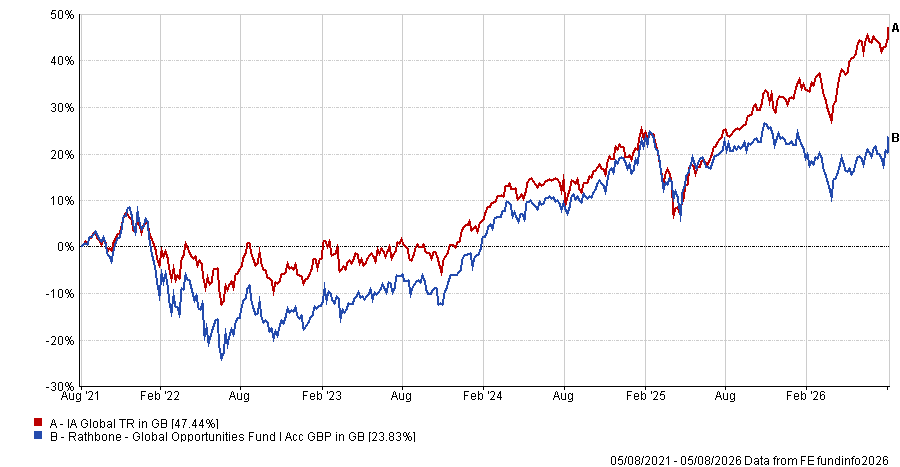
We begin with a global fund, chosen by Jemma Slingo, pensions and investment expert at Fidelity International, who pointed to Rathbone Global Opportunities. It has been managed by Alpha Manager James Thomson since 2003, with Sammy Dow serving as deputy manager since 2014.
“It is pleasingly straightforward in its approach: it wants star quality,” Slingo said.
The fund holds around 50-60 of the management team’s highest-conviction ideas. It typically steers clear of turnaround stories and businesses whose fortunes depend heavily on the wider economy, she noted.
“Performance wise, it has proved itself to be a reliable long-term holding – its lack of exposure to oil and gas has been a headwind this year but the long-term investment case remains intact,” Slingo said.
Over the 10 years to the end of 2025, the fund logged first quartile returns in the IA Global sector in five of those years.
Performance of the fund vs sector over 5yrs
Source: FE Analytics
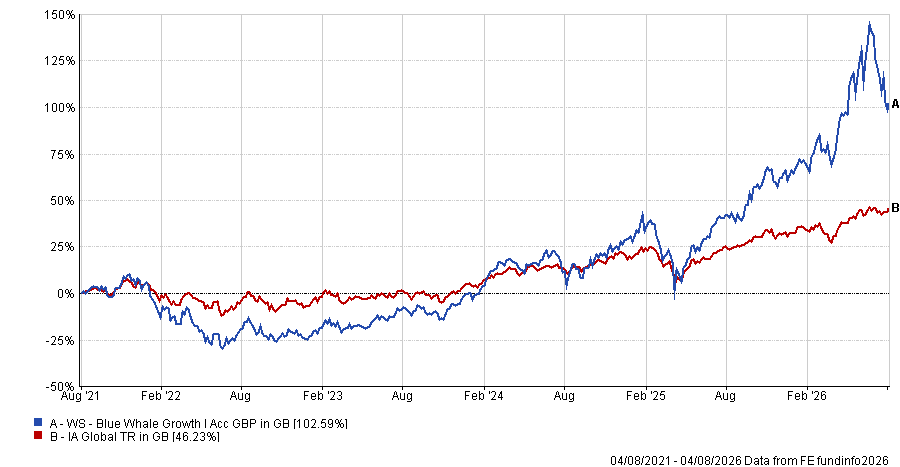
Ben Yearsley, director at Fairview Investing, suggested Blue Whale Growth, managed by FE fundinfo Alpha Manager Stephen Yiu.
With less than 30 holdings in the portfolio, the £2.4bn fund is another highly concentrated pick, targeting a mix of high-quality and high-growth stocks.
The fund currently has almost 10% invested in Nvidia, 9.7% in Lam Research and 6.8% in Flutter Entertainment.
“You often get quality-growth portfolios – like Fundsmith Equity – but this is more dynamic,” Yearsley said.
“I also like the management team, as they have a very clear process and definitely seem hungry to succeed.”
Yearsley views the fund as a core long-term growth holding – albeit higher risk and more volatile, so those with less of an appetite for risk might instead consider it as a satellite holding.
Indeed, while the fund has logged first quartile returns over one, three and five years, it has proven more volatile. For example, over the year to the end of July 2026, Blue Whale Growth was in the most volatile quartile of the IA Global sector at 35.2%.
Performance of the fund vs sector over 5yrs
Source: FE Analytics
Next, Sheridan Admans, founder of Infundly, and Tom Bigley, fund analyst at interactive investor, both suggested funds from Capital Group.
Admans went with Capital Group New Economy Fund, a $2.1bn strategy targeting long-term capital growth by investing in companies that can benefit from innovation, exploit new technologies or provide products and services that meet the demands of an evolving global economy.
“I have chosen the fund because it provides meaningful exposure to structural growth without being confined to a single theme,” Admans said.
While its exposures to technology, AI and semiconductors are important elements, with the likes Alphabet, TSMC and Microsoft featuring in its top holdings, the opportunity set also extends into healthcare innovation, digital infrastructure, evolving consumer behaviour and disruptive business models, Admans noted.
He also pointed to the fund’s multi-manager team, which includes Matthews Cherian, Richmond Wolf and others, noting that this approach combines high-conviction stock selection with a diversity of perspectives and reduces dependence on any one individual.
“The portfolio also has clear exposure to long-duration growth companies and can therefore experience periods of significant volatility, particularly when interest rates rise or highly rated technology shares fall out of favour,” Admans added.
Over one year to the end of July 2026, Capital Group New Economy Fund logged a first-quartile return of 29.9% but a volatility of 23.1%.
Bigley picked Capital Group UK New Perspective, which targets businesses that stand to gain from changing global trade patterns and multi-generational shifts in the global economy.
“While the portfolio exhibits a modest growth bias, it is not constrained by style, sector or geography, allowing the managers to allocate capital to their highest conviction ideas as market leadership evolves,” he said.
“This is reflected in the portfolio's balanced regional positioning, with materially lower exposure to the US and greater allocations to Europe than the MSCI ACWI index.”
The fund has 56.1% invested in the US versus 66.6% of the index, while it has invested 24.4% in Europe versus 14.1%.
He acknowledged that the fund has struggled versus the benchmark in more recent years – in particular in 2022 as US tech names detracted from performance, including Tesla, Shopify and Meta.
“Over a longer 10-year horizon, the strategy has demonstrated its ability to deliver through different growth and value environments, generating an annualised return of 13.5%,” Bigley said.
For investors who want their growth allocation to come from different geographies, Europe and Asia stood out.
Paul Angell, head of investment research at AJ Bell, suggested the £4.7bn BlackRock European Dynamic strategy, which features on AJ Bell’s Favourite list.
It has been managed by Giles Rothbarth since 2019, with Angell noting he “impresses as he articulates macro views, which are incorporated within the bottom-up assessment of companies by BlackRock’s 20 strong European equity analyst team”.
He also worked closely with the fund’s previous portfolio manager, Alister Hibbert.
Rothbarth looks to invest in businesses with strong cashflow and earnings stories, based on bottom-up fundamental analysis, including consideration of macroeconomic sensitivity and structural changes.
“The fund can be dynamic with regards to its growth style – for example, rotating into more cyclical names in the second half of 2020,” Angell said.
According to AJ Bell, £10,000 invested in BlackRock European Dynamic in 2016 would be worth almost tripled to around £27,000 as of July 2025.
Growth of £10,000 in BlackRock European Dynamic since 2016

Source: AJ Bell
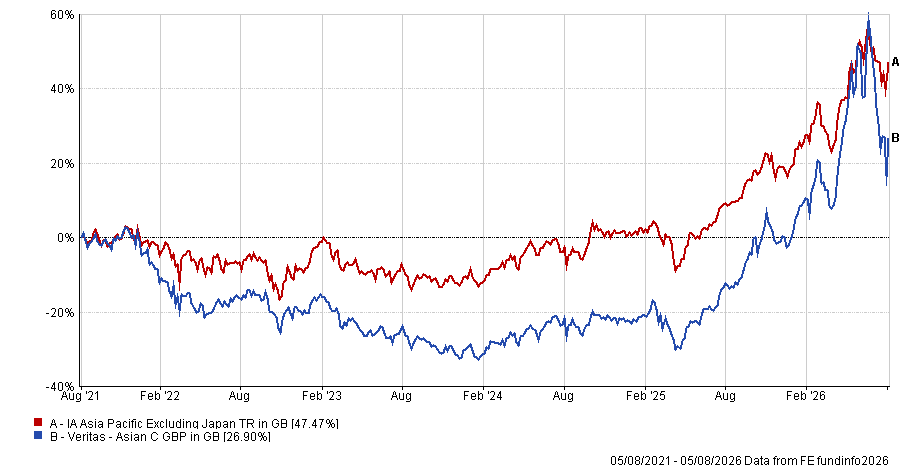
Finally, Ernst Knacke, head of research at Shard Capital, suggested the $2.7bn Veritas Asian strategy, which has been managed by FE fundinfo Alpha Manager Ezra Sun since its inception in 2004.
The fund invests in a concentrated portfolio of Asian equities (excluding Japan), with the aim of growing capital over time.
“This is a strategy with a proven competitive advantage and significant alignment of interest,” Knacke said.
“Sun combines secular themes coming out of Asia with local knowledge and in-depth company research to identify high-quality businesses with durable moats and aligned management teams.”
The result is a concentrated portfolio including TSMC, SK Hynix and Samsung.
While it has a definitive growth bias, Sun does not ignore valuation, as he is prepared to wait for the right price rather than chase an exciting narrative at any cost.
“The benchmark-agnostic, real-return mindset allows them to not merely to participate in Asia’s upside but to some extent protect investors from uncertainty and volatility,” Knacke said.
Performance of the fund vs sector over 5yrs
Source: FE Analytics
Bettina Edmondston tells Trustnet how the Liontrust Global Income and Growth fund has topped the charts over the past 12 months.
No exposure to the US mega-cap AI winners and moving towards smaller companies and emerging markets could have been a disaster five years ago. But over the past half a decade these trades are exactly where the Liontrust Global Income and Growth fund has been positioning – and to great effect.
The £198m fund, previously named RGI Global Income and Growth, is co-managed by Alasdair Birch and Bettina Edmondston and has thrived despite some surprising portfolio moves.
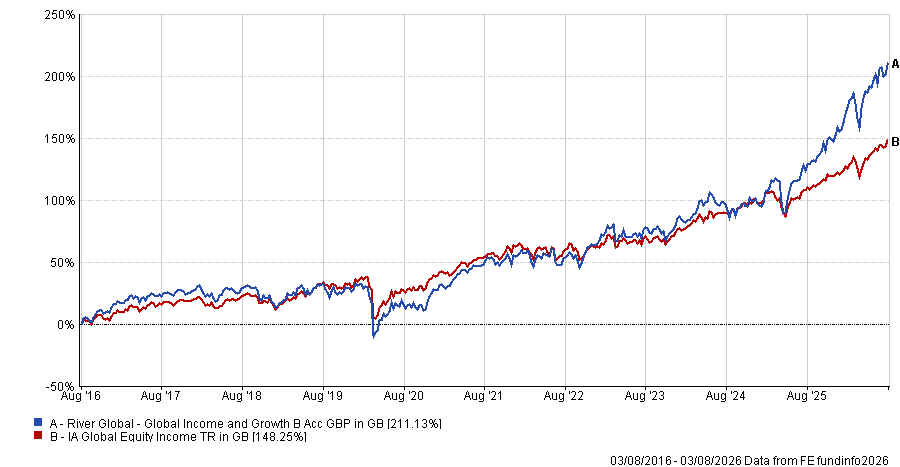
Indeed, it has been the best performer in the IA Global Equity Income sector over one year and it is a top-10 performer over three, five and 10 years too.
Performance of fund vs sector over 10yrs
Source: FE Analytics
Below, Edmondston explains why the dividend picture is better in emerging markets (EM) than the US, how the fund moved away from tech before Covid and why small-caps are becoming a much larger part of the portfolio.
What is your process?
The process is to buy high-quality businesses that can sustainably grow earnings, cash and dividends. But more importantly, we want to buy companies where the valuation doesn't compare to our five-year growth outlook.
For quality, we look at net debt to EBITDA, looking for low leverage, especially with interest rates rising. In terms of growth, we do our own template based on the next five years. We look at earnings growth, dividend growth and the cash dividend cover.
In valuation terms, we look at cash earnings – everything a company adjusts we add back in most of the time, so it's pure earnings – and we look at the P/E [price-to-earnings] in year five. Roughly, a year-five P/E below 10x is a buy, 10x to 15x is a hold, and above 15x is a sell.
Why should investors pick your fund?
I think there are two reasons. One is that we're really differentiated; you can't replicate our fund with an ETF or an index. We've always had different holdings than the peer group, or even the [IA] Global peer group. We've also had really strong performance, even while being totally different and having had little or nothing in consumer defensives or IT.
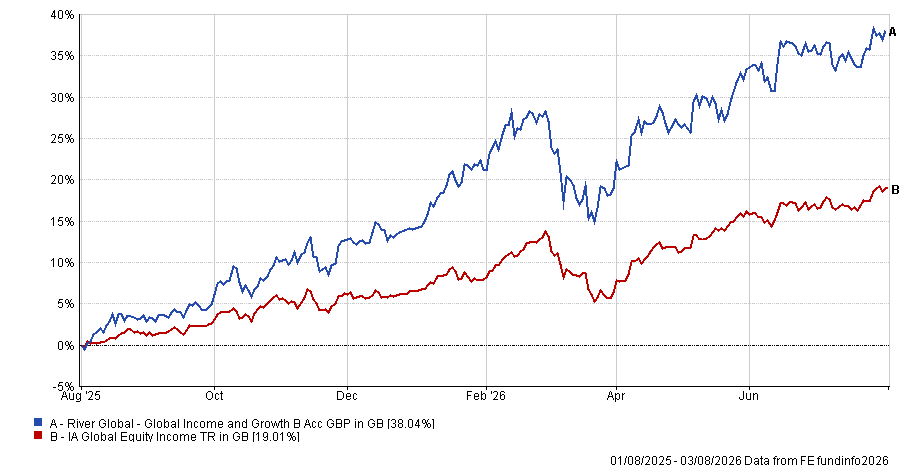
This fund is the best performer in the IA Global Equity Income sector over 12 months. How have you achieved this?
I think it's because we only have 40 holdings, so we can be really nimble and quick in reassessing things. I'll give you an example. On Liberation Day, Dell was down 25% within three days and we doubled our holding because we were convinced it wasn't going to get hammered. We normally have really low turnover but when volatility rises, which has been the case over the past two or three years, our trading moves up too.
Performance of fund vs sector over 1yr
Source: FE Analytics
If you need to be nimble, is there a maximum size that this fund can reach?
I don't think it's necessarily the size that makes us nimble – it's the 40 holdings and the fact that we know every company inside out.
We reckon we can grow the fund, in its current composition, up to £2bn. If we look at every company we own and keep the same holding size – 2%, or whatever it is – we can easily scale and still have the same holdings.
Why does this fund have such large positions in mid- and small-caps (18.8% and 30%, respectively)?
It has got a bit bigger in the past three to five years because we find more opportunities in that area, but you have to think about this on a global basis: small-cap means [a market cap of] up to £10bn.
When the fund was launched, we were looking for globally leading businesses as a whole, whereas sometimes we now look for businesses that are leaders in just one or two areas.
Overall, nothing is static in this fund; it's very process-driven, very bottom-up. The sector weightings have been quite cyclical over the past five years: we were very much into tech in the late 2010s and into consumer stocks before that, when the fund was launched.
It's going to look totally different in five years; I have no idea exactly how. It's just wherever the process takes us, wherever we find attractively valued ideas with a decent dividend yield.
Why do you have very little technology today?
It really started coming out of Covid when we saw this capex cycle coming and we decided we wanted to own the picks and shovels rather than the nameplate. That applies to capex, to AI, really to every sector, because then you don't have to decide who's going to be the winner in the end.
It doesn't matter whether Nvidia, TSMC, or Intel wins [the semiconductor market share], they need Ebara's machines. It doesn't matter whether Google, Amazon, or Microsoft wins in data centres, they need servers from Dell. So that's why we like to go a little further up the value chain.
The other reason we don't own a lot of the large-cap names is that we want a 2% dividend yield, ideally either immediately or within year one or two, and a lot of them are still well below 2%.
We don't run a barbell approach; everything in the portfolio has to pull its weight on valuation, growth and yield. With only 40 companies, they all have to do the same job and improve the characteristics of the fund.
Does this fund invest in emerging markets?
We've moved more into EM in the past five years. The overwhelming reason is that the dividend picture looks much better in emerging markets. If you look at the US dividend yield on the S&P, it's gone from top-left to bottom-right over the past 20 years and I think the S&P yield is now around 1%, so it's very difficult to find a sustainably growing 2% yield there.
The other factor is that we now have a bit more leeway in what counts as a ‘leader’; it can be regional.
But [investing in the emerging markets] does take much more work. For example, we have a Mexican bank in the portfolio, Banorte. When we first invested, we had five calls and it took us about six weeks to get comfortable. It takes a long time but it's really worth it.
What has been your best performer over the past year?
For the 12 months to the end of July, the best performer was Dell, up over 200%. It's probably the most volatile stock we've ever owned in the portfolio, just given what's going on in AI, but it was definitely the best contributor.
When we bought it in November 2023, everybody thought: ‘Well, it's a laptop company, it's going to get destroyed by AI’. But it has a really big server business and that's what the hyperscalers need. So it's these little pockets within companies that get overlooked sometimes, which we try to find, and then we extrapolate the growth out five years.
And your worst?
The worst were two companies in the construction space: Saint-Gobain, the French building materials company that makes plasterboard, and Wienerberger, which makes bricks, piping, and similar products. They were both down just over 20% in the past 12 months.
When we entered the year, we were looking for a pick-up in construction, especially residential construction in North America, but that unfortunately hasn't come through. They're still very good long-term holdings and we're still holding on to them.
What do you do outside of fund management?
During the week, I try to go to the gym after work every day just to clear my head. Sitting at a desk for eight, nine, or ten hours a day, you just have to get your body moving and your mind to relax. On the weekend, to get away from the screen, I either go out on the motorbike to clear my head or go for a walk.
Terry Smith and Nick Train have lost to the market over the past five years. But what have we been doing with our portfolios?
There's an Italian saying for wanting two things at the same time that were never on offer together. We say: you want the flask full and the wife merry.
Looking beyond the slight misogyny, the point is that one excludes the other. A more elegant way of putting it might be that it’s an aut aut, an either or.
Yet I have the impression that we don’t always extend the same understanding to fund managers. We want to make all the money we can but also never lose a penny. The protection of a diversified portfolio and the upside of someone willing to bet everything on being right. Sometimes we want that from the same person, in the same fund.
But even the best can’t do it. Two of the most scrutinised managers in the country, Terry Smith and Nick Train, are behind the market in each of the past five discrete 12-month periods to the end of July.
The numbers look pretty dire. Fundsmith Equity rose 0.8% in 2025 against the MSCI World's 12.8%, then fell 2.9% in the first half of 2026 while the index gained 11.2%. Assets have roughly halved.
Lindsell Train Global Equity went from £5.2bn of assets under management to £2.2bn. The closed-ended Finsbury Growth & Income's net asset value fell 21.3% in the year to March 2026, against a 16% rise for the MSCI World, with a 14.4% loss in the first half alone.
Performance of funds against indices and sectors over 5yrs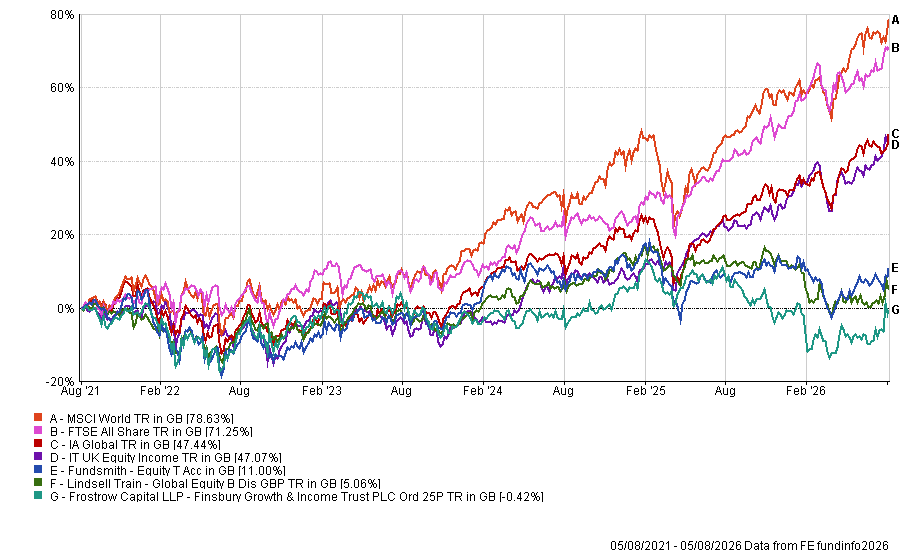
Source: FE Analytics
Maybe what we want is for managers to follow one process without wavering, whatever the market is doing. If that's the real job, underperformance needs reframing, and so does how we work out when a manager has lost the plot rather than just gone quiet for a while.
But then in July, as Fundsmith Equity was heading for a fifth discrete 12-months running behind the MSCI World, the manager tore up his own “buy good companies and do nothing” rule, turning over 51% of the portfolio to buy into Uber and Netflix.
Admitting you had been wrong and changing your process is a bold move but one that some commentators, like Brian Dennehy, founder of FundExpert.co.uk, appreciated.
“Fundsmith basically made no money last year, and the fund went from £20bn to £12bn as people left. Lindsell Train was down 11% last year and went from £4bn to £2b. I'm always surprised how much money stays on board when you've underperformed by about 20% in a year,” he said.
“Adapting is absolutely vital. Only in the last couple of weeks has Terry Smith announced he's making changes. It's taken him a while to get there.”
So then maybe we want managers to adapt. But not too frequently, because that would mean we investors wouldn’t know what we’re buying…
Compared to Smith, Train went the other way. In the closed-ended Finsbury Growth & Income, the board raised gearing on towards £100m rather than change process: the decision was to take up more risk, doubling down on the portfolio.
Was this a better response? Is the risk justified and what happens if he is wrong?
Laith Khalaf, head of investment analysis at AJ Bell, said that a bad five years is simply the cost of backing conviction over an index.
“If you ask professional fund selectors what the most challenging part of their job is, deciding what to do about an underperforming manager comes near the top of the list,” he said.
“Terry Smith is no shrinking violet and his pugilistic defence of his strategy stands in stark contrast to the deeply apologetic tone struck by Nick Train. You have to accept the fallow with the fertile.”
When we buy into a manager's philosophy, we must accept the losses that come with it and be able to tell them apart from the losses that come from a manager breaking his own rules, which is what undid Neil Woodford.
Alternatively, we can choose to sell and move on, rather than staying loyal to a manager that we lost conviction in. There’s no third option. So do you choose the wife or the flask?
Matteo Anelli is deputy editor at Trustnet. The views expressed above should not be taken as investment advice.
Six strategies out of 16 made double-digit returns in the first half of 2026.
Six funds among the 16 most recommended by the top UK platforms in 2025 have logged a double-digit performance this year; nine (56%) returned between 9% and 3% and only one concluded the year-half-year at a loss.
Below, using FinXL data, Trustnet reveals the performance of the funds with more than three best-buy recommendations, as awarded last year by the analysts working on Hargreaves Lansdown’s Wealth Shortlist, AJ Bell’s Favourite Funds list, interactive investor’s Super 60 list (today known as Highly Rated Funds), Fidelity’s Select 50 and Barclays’ Smart Investor Funds list.
The favourite
The fund with the most backing was BlackRock Continental European Income, convincing analysts at all platforms except Fidelity.
Its returns in the first half of 2026 however were somewhat muted: at 6.5%, it fell short of the IA Europe Excluding UK sector average of 8.9%. This is a third-quartile performance, in line with the third-quartile return achieved in 2025.
Performance of fund against index and sector over 1yr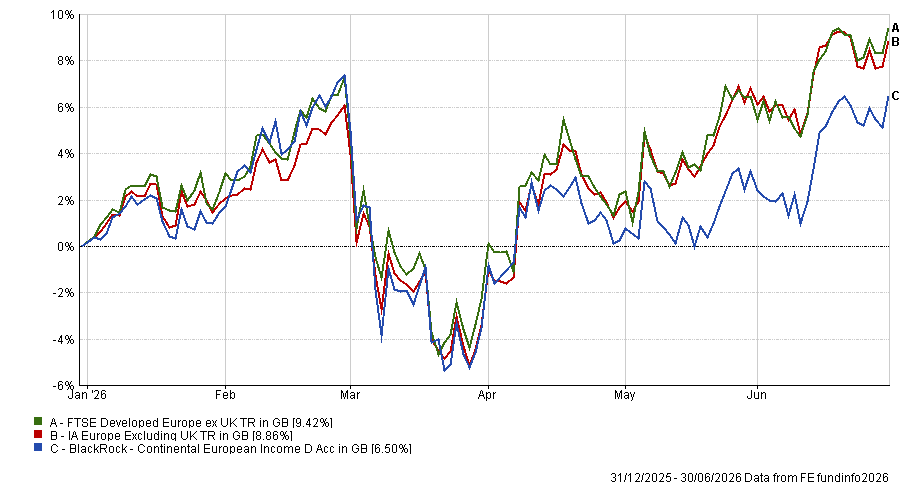
Source: FE Analytics
Managed by Brian Hall and Stuart Brown, the fund was one of the most bought of last year, adding about £276m of new money; however, Europe as a whole dropped from the best-performing market in 2025 to the worst in 2026, and investors have started to ditch European funds more recently, as we covered on Trustnet last week.
Hargreaves Lansdown analysts praised its “more defensive investment approach that could help limit volatility compared to peers in times of uncertainty”.
No other fund gained quite as much consensus, and with all other names in the list featuringe on three best-buy platforms, not four.
Tracker funds
At a whopping 53.6%, the highest return came from iShares Pacific ex Japan Equity Index, which tracks the performance of the FTSE World Asia-Pacific ex-Japan index.
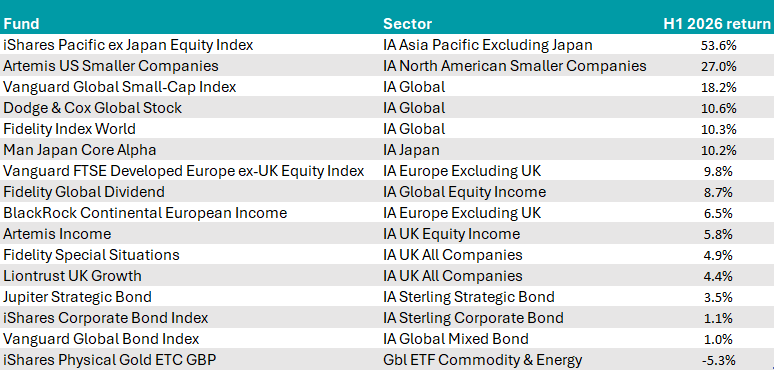
Source: Trustnet
Taiwan and South Korea are the region's heaviest weights, and both markets have been on a tear thanks to TSMC, Samsung, and SK Hynix riding the surging AI chip demand.
No other fund came close to this result, with the next one up at approximately half the gains.
The other passive funds in the list were Vanguard Global Small Cap (18.2%), which came third overall, Fidelity Index World (10.3%) and Vanguard FTSE Developed Europe ex UK Equity (9.8%).
In fixed income, iShares Corporate Bond Index and Vanguard Global Bond Index featured at 1.1% and 1%, respectively.
Active funds
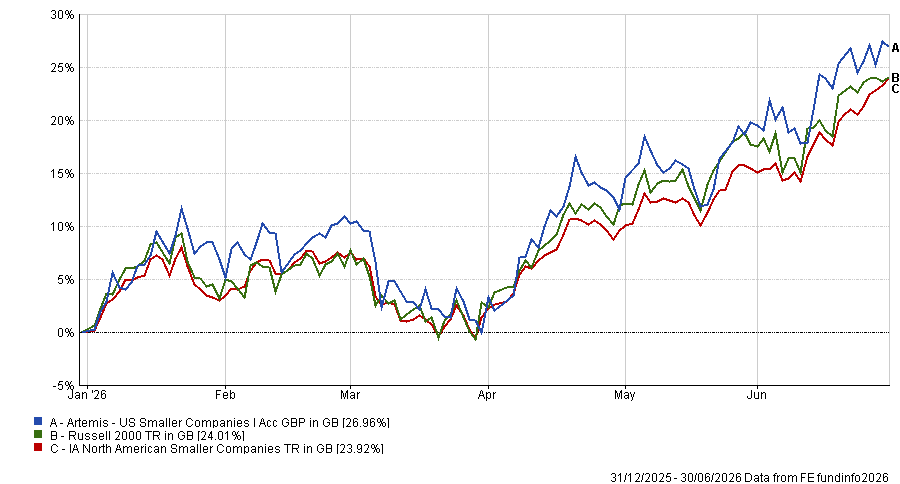
We then move to Artemis US Smaller Companies, whose 27% (versus the sector’s 23.9%) gained it the second place in the ranking.
Performance of fund against index and sector over 1yr
Source: FE Analytics
IA North American Smaller Companies was the fourth-best sector in the first half of the year, more than double the 10.7% from the average fund in the broader IA North America peer group, as we revealed recently.
AJ Bell analysts said the fund benefits from “an extremely experienced figurehead”, manager Cormac Weldon, who has been involved in analysing US equities for over three decades.
“The investment approach has been well honed over the years and considers top-down macro factors to identify themes and pairs these with strong bottom-up fundamental company analysis,” they said.
The process is applied throughout the North American franchise at Artemis and is additionally used on the US Select fund.
Speaking to Trustnet recently, Weldon described his process as style-agnostic.
Its stablemate Artemis Income was also in the list.
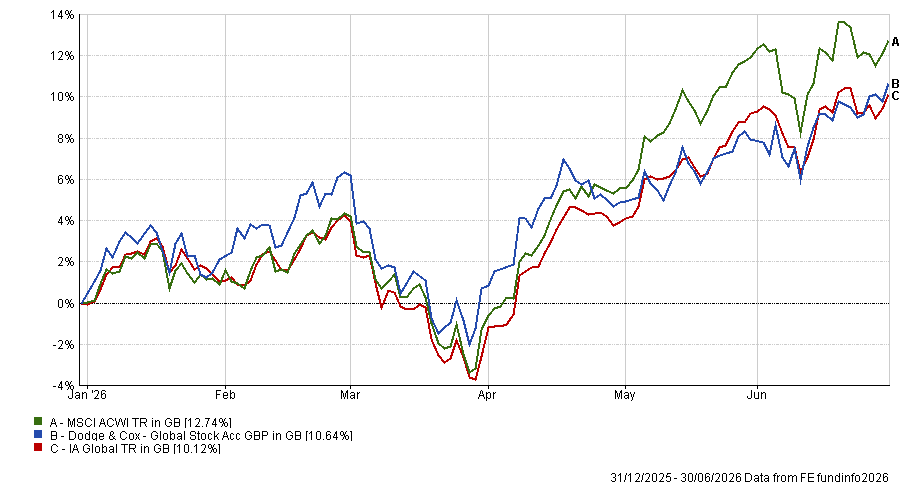
At 10.6%, Dodge & Cox Global Stock was part of interactive investor’s and Fidelity’s best buy lists last year and in January this year was added to AJ Bell’s list too. It’s not only analysts who like it: investors couldn’t keep their eyes off this strategy either in the first half of the year.
It is a £5bn global fund that buys high-quality businesses that appear undervalued due to short-term disruptions but have long-term potential.
It is managed by a committee, which AJ Bell research analyst Alex Wickham said he liked as it placed an “emphasis on group management over individual leadership”.
Its value style had underperformed growth investing for an extended period but has closed the gap in the recent past and was narrowly ahead in 2026's first half.
Performance of fund against index and sector over 1yr
Source: FE Analytics
At a close 10.2%, Man Japan Core Alpha was the next active name on the list.
Deemed by Hargreaves Lansdown’s analysts as “an excellent way to invest in the world's third largest economy”, the fund is run by Jeff Atherton, who uses “a clear, disciplined approach, which has served the fund well over the long term”.
This fund too leans towards value as its investing style, which is why Tom James, investment analyst at Hargreaves Lansdown, suggested pairing it with the more growth-oriented Baillie Gifford Japanese.
With single-digit returns, Fidelity Global Dividend, Fidelity Special Situations, Liontrust UK Growth and Jupiter Strategic Bond rounded off the list.
At the very bottom, with a loss of 5.3%,) was the iShares Physical Gold ETC (exchange-traded commodity), which tracks the price of gold.
The yellow metal hasn't been calm this year: it topped $5,500 an ounce in late January before dropping below $4,000 by June.
The platform’s research team has picked out five managers with strong sector-relative performance since taking charge of their funds.
AJ Bell has picked out five fund managers who have beaten their peer groups since taking charge of their funds, with technology and AI-linked strategies dominating the list.
Paul Angell, head of investment research at AJ Bell, said star-manager culture is no longer as prominent as it once was in the fund management industry and rising stars should be considered “carefully rather than blindly followed”.
“However, ” he said, “our data suggests that talent continues to come through”,” he said..
He Angell continued: “Fund buyers typically focus on experience and long-term performance track records, therefore short-term performance alone isn’t always enough. It can also be worthwhile to focus on fund managers with established industry experience who have delivered strong performance since taking over a fund.
“The 2026 data shows that rising star fund managers are still out there, even if the industry is less comfortable using the phrase than it once was.”
The analysis covered managers with tenures of between two and five years across IA sectors.
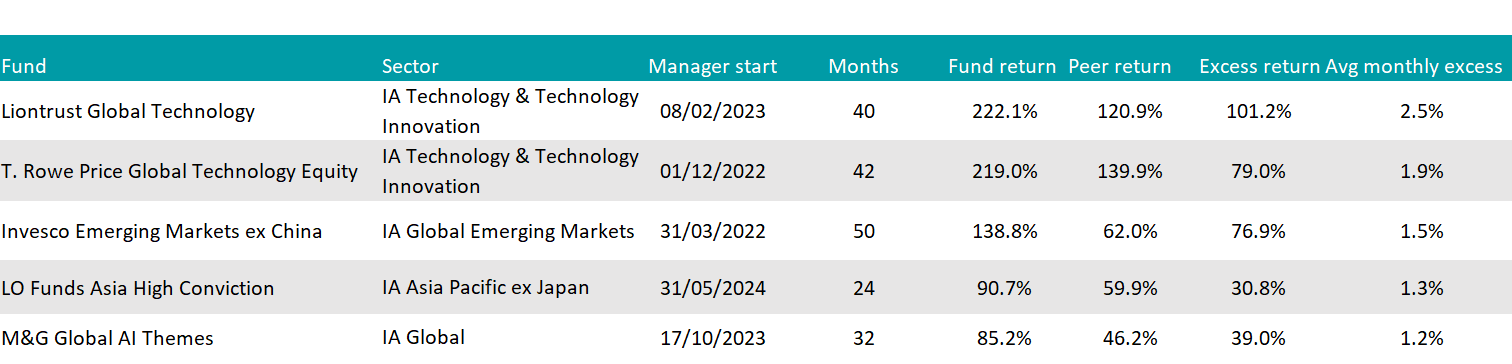
Source: AJ Bell. Data to 30 June 2026.
The strongest performer was Liontrust Global Technology, run by Storm Uru since February 2023 and joined by Clare Pleydell-Bouverie two months later.
The fund has returned 222.1% since Uru took over, against 120.9% for the IA Technology & Telecoms sector – an excess return of 101.2 percentage points over 40 months or 2.5 percentage points a month, the highest average monthly figure in AJ Bell's table.
Its top ten 10 holdings include five of the Magnificent Seven (no Tesla and Microsoft appear), Broadcom, TSMC and SK Hynix. Other well-known names include US connectors company Amphenol and Japanese computer memory manufacturer Kioxia Holdings.
“The fund has clearly benefited from a period in which technology companies, particularly those exposed to AI, semiconductors and digital infrastructure, have dominated global equity markets,” said Angell.
“The obvious risk is that technology leadership has been narrow and valuations in parts of the sector are demanding. A strong technology fund can look brilliant when the market backdrop is supportive, but the true test comes when leadership rotates or expensive growth stocks come under pressure.”
The ongoing charges figure (OCF) is 0.87%.
Performance of fund against index and sector over 1yr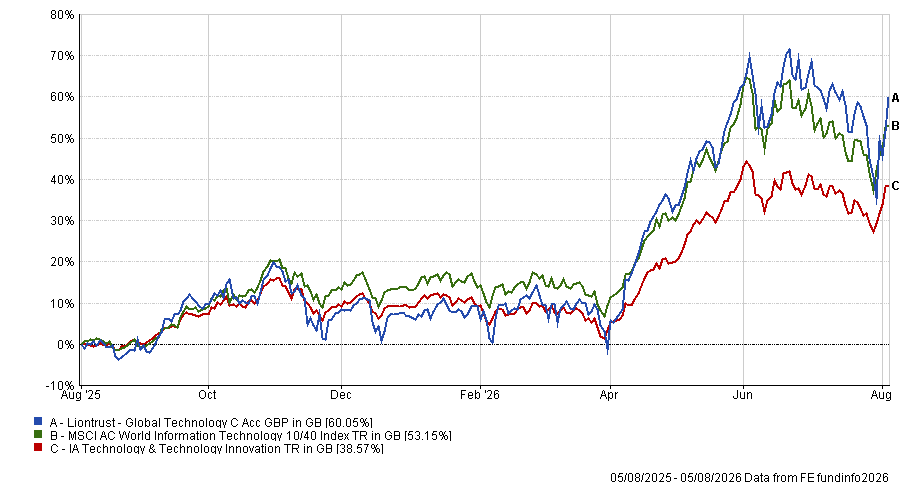 Source: FE Analytics
Second on the list was the £1.2bn T. Rowe Price Global Technology Equity fund, with manager Dominic Rizzo having run the firm's global technology strategies since December 2022.
The fund has returned 219.0% against 139.9% for the peer group, an excess return of 79.0 percentage points over 42 months, or 1.9 percentage points a month.
Compared to its benchmark, the MSCI AC World Information Technology 10/40 Net index, the fund is overweight semiconductor and internet companies (by 11.0 and 2.6 percentage points, respectively) as well financial services; and underweight hardware (-11.0 percentage points) and software names (-4.5).
Angell said the scale of returns across the technology sector made it harder to separate genuine stock-picking skill from being in the right part of the market at the right time.
“The better question for fund buyers is not just who has performed best in the AI-led rally, but who has a process capable of adapting when the next phase of the cycle arrives,” he said.
Performance of fund against sector over 1yr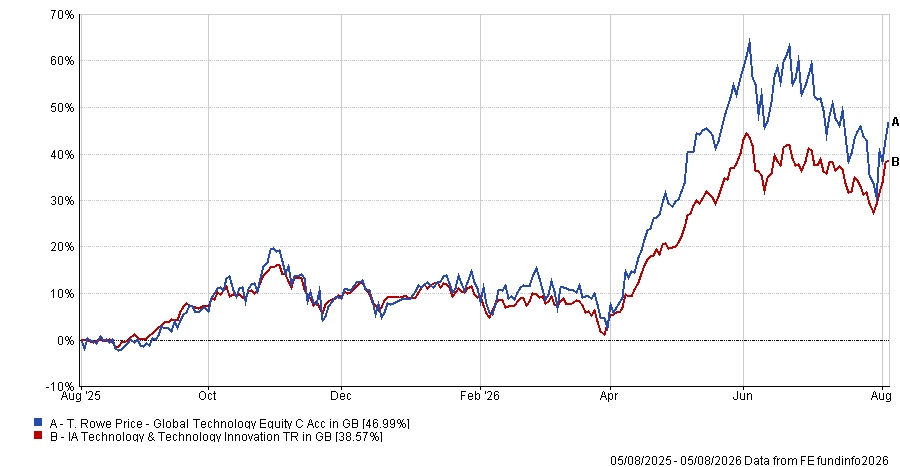
Source: FE Analytics
Invesco Emerging Markets ex China ranked third.
FE fundinfo Alpha Manager Charles Bond has overseen the fund since March 2022 alongside James McDermottroe, delivering a 138.8% return against 62.0% for the Global Emerging Markets sector – an excess return of 76.9 percentage points over 50 months or 1.54 percentage points a month.
Excluding China gives the fund greater exposure to markets including India, Taiwan, South Korea and Brazil, which Angell said had provided a structural tailwind as China faced its own economic headwinds.
“The performance is impressive, but investors should be clear what they are buying. An emerging markets ex-China strategy is not simply a lower-risk version of emerging markets,” Angell warned.
“It is a different allocation with its own biases, including potentially greater exposure to India, technology hardware, semiconductors and country-specific valuation risks.”
Performance of fund against sector over 1yr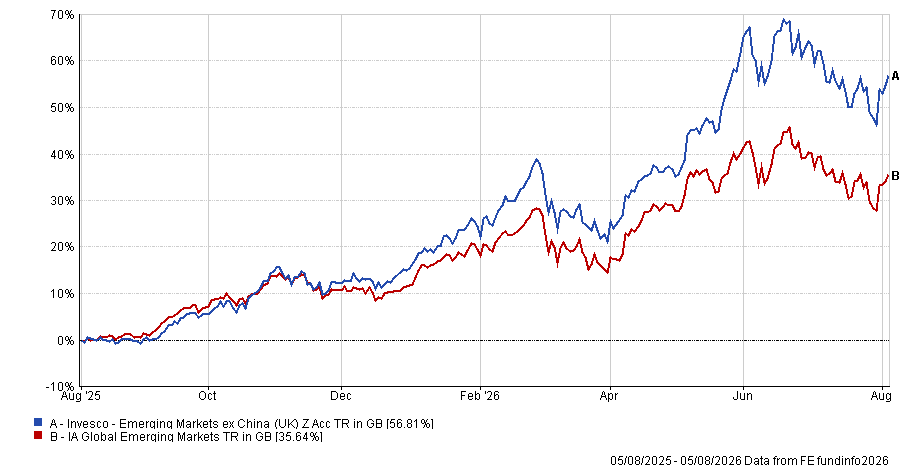
Source: FE Analytics
Next up, LO Funds Asia High Conviction, run by Ashley Chung, Faye Gao and Wee Jia Low since May 2024, returned 90.7% against 59.9% for the Asia Pacific ex Japan sector, an excess return of 30.8 percentage points over 24 months. This performance gained it a maximum FE fundinfo Crown rating of five.
The fund's two-year track record was at the minimum threshold used in the analysis, meaning the managers' tenure was still short relative to the other names on the list.
“The important caveat is that Asia Pacific ex Japan funds can be heavily influenced by country allocation, currency moves and exposure to technology hardware or China-related sentiment,” he said.
“The early relative performance is strong enough to warrant attention, but the next test is whether the process can keep adding value across a less supportive regional backdrop.”
Performance of fund against sector over 1yr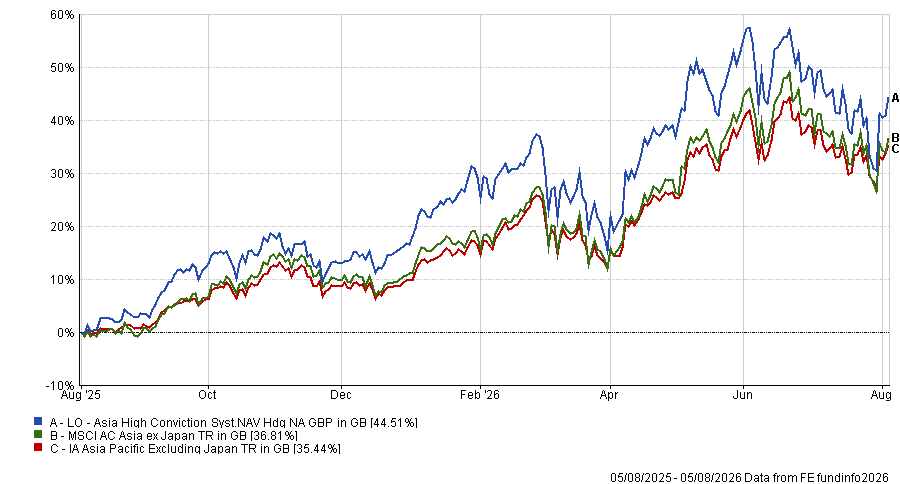
Source: FE Analytics
Finally, M&G Global AI Themes, managed by Jeffrey Lin, rounded out the list with “a very strong” start since launch in October 2023.
“Lin’s challenge will be to show that the fund is more than a market beta play on a popular theme. The early numbers are strong, but the next test will be whether the process can continue to add value if enthusiasm for AI cools or leadership within the theme broadens,” Angell concluded.
Investing based on growth or value principles means having one hand behind your back, says the manager.
Late in 2023, Cormac Weldon, manager of Artemis US Select, bought data storage company Western Digital. It was loss-making, carrying a weak balance sheet and by his own account considered “not even value, but just a poor business”.
He bought it as a beneficiary of AI spending at a point when weak balance sheets at both Western Digital and rival Seagate meant neither could fund new production capacity. That scarcity collided with the AI industry's demand for hard disk drives.
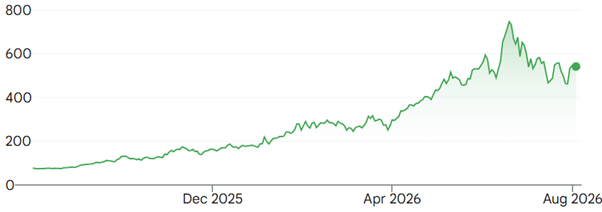
Today, after its rally (the stock is up about 600% over 12 months, as shown in the chart below), the market has completely reframed Western Digital.
“It's grown a huge amount,” Weldon said. “I don't know if it still appears in value baskets – it's probably in growth, because it's grown so much.”
Performance of stock over one year
Source: Google Finance
This goes to show how none of these labels are truly binary and no stock stays in one camp forever.
“[I don’t like using] growth or value because they're sort of bogus concepts,” he continued. “A stock doesn't know it has a label and that it's supposed to perform at a certain point in the market. A stock is a business that has fundamentals, and then the market will value those fundamentals based on what it sees.”
As Weldon recently told Trustnet, Artemis US Select is run in a style-agnostic way. Put simply, the manager said he should never have to tell a client the market and his style of investing are at odds with one another.
The process starts at the level of the individual business, asking whether it is getting better or worse, and looking for upside worth at least twice the downside if the call is wrong. Investment style does not enter into that assessment.
“We won't not look at a stock because it's considered value, or it's considered high growth, or whatever,” Weldon said. “We'll just analyse the fundamentals of the business and then decide whether it offers an asymmetric risk [versus] reward.”
Screening out companies based on a certain style of investing before conducting individual analysis means “you're not competing against the market, you're competing against a part of the market... you're sort of doing it with one hand behind your back,” he said.
The same scepticism applies to the opposite label.
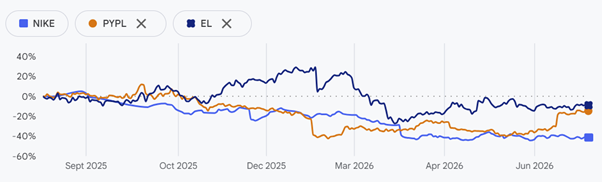
“A good company doesn't necessarily mean a good stock,” he said, citing consumer brands Nike and Estée Lauder, as well as payments processor PayPal, as businesses with strong reputations that have not consistently rewarded shareholders.
“If a good company is producing better and better results, sure that'll get rewarded,” he said, “but if it's now producing exactly what we expected and consensus has caught up with reality, it's probably not going to be that strong a performer”.
“Trees don't go to the sky,” he added. “Maybe Nike gets its sneakers wrong and other competition comes along, maybe Estée Lauder doesn't have a clue what it’s doing in China and it was all smoke and mirrors anyway”.
The stocks have trended lower over the past 12 months, as the chart below illustrates.
Performance of stocks over one year
Source: Google Finance
There are however moments when turning to one over the other can make sense, he admitted. For example, value can become “the more obvious trade” when the market prices it too cheaply.
“People have looked at growth and given it high, high, high multiples,” he said. “By definition, if they’re buying growth, they're selling all these value stocks, and value underperforms a lot. There can be occasions when you just want to say, actually, that's the pool I want to fish in.”
He cited early 2009, during his time at Threadneedle, as the clearest recent case. Back then, markets were pricing in economic collapse.
“This economy's over, we're going into depression, the Fed isn't going to be able to help, the government isn't going to be able to help, we're done for,” he said, describing the mood at the time. Value stocks traded at their cheapest relative to the broader market outside the Great Depression.
Right now, he sees no equivalent opportunity in value as a cohort. “Value isn't cheap relative to the market, that's the interesting thing,” he said.
“The framework I'm using is, if you look at the cheapest quarter of the market and compare its valuation to the average stock, value scores average compared to all of its history. 2009 and then early 2020 were massive outliers in terms of valuation,” he concluded.
Held together, the US and Canada come close to a complete equity package
Never has so much of the world's wealth ridden on a single rocket. The AI trade now accounts for almost half of the S&P 500, a share that will only climb as record-breaking mega-cap tech initial public offerings (IPOs) land in the index. And with the US making up nearly 70% of the MSCI World, global trackers are on a parallel trajectory. Has diversification within equities ever been harder to come by?
Of course, no sensible investor would abandon AI exposure altogether. We bought Nvidia in 2016 at around $1.35 a share and have since banked some $200m of gains while still holding a $100m position.
Equities have long been one of history's great engines of wealth precisely because investors could spread their risk across many of them. Yet today, many portfolios are tied to the same trade, intentionally or not. The prudent will want ballast for the journey – and need not leave the continent to find it.
The case for boring
Canada is a boring country by most rankings of excitement. From the perspective of today's markets, though, there is no higher compliment.
Canada's stocks have made it the best-performing market in North America: over the past twelve months, the S&P/TSX Composite has returned around 25% against roughly 18% for the S&P 500. It has done so without relying on a single Magnificent Seven stock, and still trades at a forward price/earnings ratio of around 16x against more than 21x for the US, with roughly double the dividend yield.
Three things make Canada the natural complement to US exposure. The first is its foundation in asset-backed sectors. Where the S&P 500 is a concentrated wager on technology, the TSX is built on banks, energy and mining.
Perhaps the most stable in the world, Canada's tightly regulated banking system has weathered two world wars, the Great Depression, 1970s inflation, the 2008 financial crisis and the Covid-19 market crash – all while maintaining consistent dividend payouts, unlike the US or UK.
Its resource endowment is a lottery win of geography and geology. The country is a top five global energy producer sitting atop an estimated $1.7trn of natural resource wealth spanning uranium, oil, gas, potash, gold, copper and timber. With the US having virtually no potash of its own, American harvests depend on Canadian fertiliser, while the Athabasca Basin holds some of the world's richest uranium grades just as the nuclear renaissance gathers pace. Such assets are driven by commodity prices and cash flows rather than distant earnings estimates, with little risk of obsolescence.
The second is political stability. Abundance in the ground is common, but abundance paired with the rule of law, an independent central bank and alignment with the West is rare and getting rarer. As Washington turns inward and populist noise rises across the developed world, Canada's calmer politics offer exposure to the decade's defining themes without the geopolitical risk premium that can accompany them.
The third is simply the price you pay. The market may be famous for its banks and miners but beneath the surface hide world-leading companies comparable to their US counterparts, flying under the radar at more attractive valuations.
Celestica makes the high-speed hardware expanding global data centres and sits squarely in the AI supply chain – its AI-related sales surged 80% last quarter, giving investors all the disruption of Silicon Valley at a Canadian discount. Similarly, Aecon, the leading contractor for Canada's nuclear reactor fleet, carries a record C$10.7bn backlog into a national infrastructure boom, yet is priced well below US grid and data-centre builders.
Look across then to MDA Space. The five-decade incumbent behind the Canadarm, the iconic robotic arm used on NASA's Space Shuttle for 30 years to manoeuvre, deploy or capture payloads, is doubling its satellite capacity against a C$3.7bn backlog. This equates to two times its annual revenues and the business is profitable. Set that against SpaceX's interstellar IPO, which came at some 130x revenues despite a near $5bn loss in 2025.
The friction next door
Of course, good portfolio companions don't always make easy neighbours, and Canada's relationship with the US is the biggest test of that. This escalated this week as Washington moved to impose an additional 50% tariff on a range of Canadian goods, covering some $20bn of exports and taking effect within 30 days, in response to what it calls discriminatory Canadian trade practices. Potash, critical minerals and the great majority of energy exports remain untouched, while the pain, for now, is concentrated in autos and consumer goods.
Canada is not without leverage of its own. Its dollar-for-dollar response to US steel and aluminium tariffs in 2018 helped bring those tariffs down within a year, and more recent provincial measures have already shown real teeth. The two economies also remain deeply interwoven – the average car part crosses the border seven times before final assembly – giving both sides reason to avoid disrupting a well-oiled machine.
Held together, the US and Canada come close to a complete equity package: the growth engine of the age and its natural counterbalance. The rocket may well reach orbit, and investors should hope it does, but every mission still needs a ground crew. For portfolios straining under the weight of a single trade, that ballast is waiting just north of the border.
Greg Eckel is portfolio manager of Canadian General Investments. The views expressed above should not be taken as investment advice.
Fund selectors highlighted strategies from M&G, Fidelity and more.
Value investing has surged to the fore in recent years, as markets have increasingly been driven by expensive, momentum-driven stocks.
With value in the ascendent, Trustnet asked fund selectors which value-focused funds and investment trusts they would back.
Simon Woodacre, fund research analyst at Quilter Cheviot, suggested the £5.4bn M&G Japan fund.
The strategy has demonstrated its ability to generate alpha across a range of market environments, driven by “a combination of strong stock selection, effective portfolio construction, a comprehensive approach to risk management and robust corporate governance practices,” Woodacre said.
Managed by Carl Vine and FE fundinfo Alpha Manager Dave Perrett, the fund aims to provide a combination of capital growth and income to deliver a higher return than MSCI Japan over any five-year period.
Woodacre noted that Vine’s “disciplined investment approach and strong portfolio-management skills have enabled him to identify attractive opportunities within the Japanese market while actively managing existing positions”.
The strategy does not pursue a deep value strategy, he added, and is therefore less exposed to style headwinds and to some of the macroeconomic challenges that may weigh on that part of the market.
“The fund’s more pragmatic interpretation of value allows it to invest selectively in higher-growth companies, including businesses benefiting from the ongoing build-out of AI,” Woodacre said.
M&G Japan’s 60-stock portfolio includes overweights to Sony, Orix Corporation and Nikon.
Woodacre viewed it as a core Japanese equity holding, ideally complemented by a strategy with “a stronger growth orientation, particularly one focused on companies benefiting directly from AI adoption or participation in the AI supply chain”.
Last month, Trustnet identified M&G Japan as the only actively managed fund in the IA Japan sector to combine lower cost with a top-decile 10-year return. It has an ongoing charges figure (OCF) of 0.47%.
The fund has performed especially strongly since 2021, logging first- or second-quartile returns in every calendar year since that point.
Performance of the fund vs sector and benchmark over 5yrs
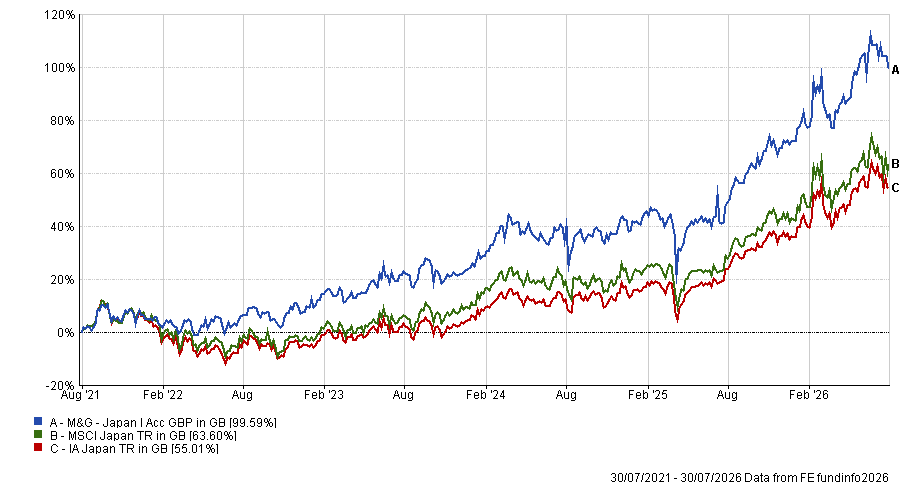
Source: FE Analytics
Meanwhile, Nicholas Hyett, lead alternatives analyst at Hargreaves Lansdown, chose T Rowe Price Global Value Equity, a fund that typically holds between 80-100 stocks spread across the value spectrum, from deep value to out-of-favour quality companies.
The fund, managed by Sebastien Mallet and Marta Yago, does not stray too far from the MSCI World benchmark and as a result its top holdings include tech giants Alphabet, Microsoft and Micron Technology.
“This makes it a core holding but the fund is still substantially different to a tracker,” Hyett said, noting that it has 15% less in the US than the MSCI World index, with meaningful overweight positions in Japan, Canada and France.
The fund also has an average price-to-earnings ratio of 17.8x versus the benchmark’s 23.5x.
“T Rowe Price Global Value Equity’s broad exposure, backed by significant resources, could make it appealing to investors that still want broad stock market exposure but are nervous about valuations in the US, or who simply want to diversify a portfolio dominated by global trackers,” Hyett said.
He next suggested the Fidelity Special Values investment trust, highlighting its “excellent pedigree”, having previously been managed by Anthony Bolton.
“[Alpha Manager] Alex Wright took over the investment trust and has continued to deliver appealing returns for investors,” he said.
Indeed, the trust has logged first-quartile returns and outperformed its FTSE All Share benchmark over one, three, five and 10 years to the end of June 2026 – gaining 201.8% over a decade.
“That is no small achievement given its strict value style in a period when value has mostly been out of favour,” Hyett noted.
Unlike its sister fund Fidelity Special Situations, which is also managed by Wright, the trust owns smaller, less liquid companies – with around 30% invested in FTSE 250 companies and 10% in the FTSE Small Cap. Its top positions include Smith & Nephew, AIB Group and Derwent London.
“Being able to fish in these under-covered corners of the market is a significant benefit of the trust structure, as is the ability to add gearing to enhance returns – albeit at the expense of increased risk,” Hyett said.
“We also think the trust structure is well suited to Wright’s deeper value approach, which often requires patience and as investors will know only too well can go through periods of substantial underperformance.”
The trust is currently trading at a slight 0.4% premium to net asset value (NAV).
“The scope for the trust to move to a discount, together with the volatility inherent in a deeper value approach with exposure to smaller companies, means it is likely to be a satellite holding for most investors, sitting as part of a broader, more diversified portfolio,” Hyett noted.
Fidelity Special Values was also the pick of Tom Bigley, fund analyst at interactive investor, noting its “impressive long-term track record”.
“What makes the strategy stand out is its disciplined, bottom-up approach to identifying businesses trading on depressed valuations before improving fundamentals become widely recognised,” Bigley said.
Performance of the trust vs sector and benchmark over 5yrs
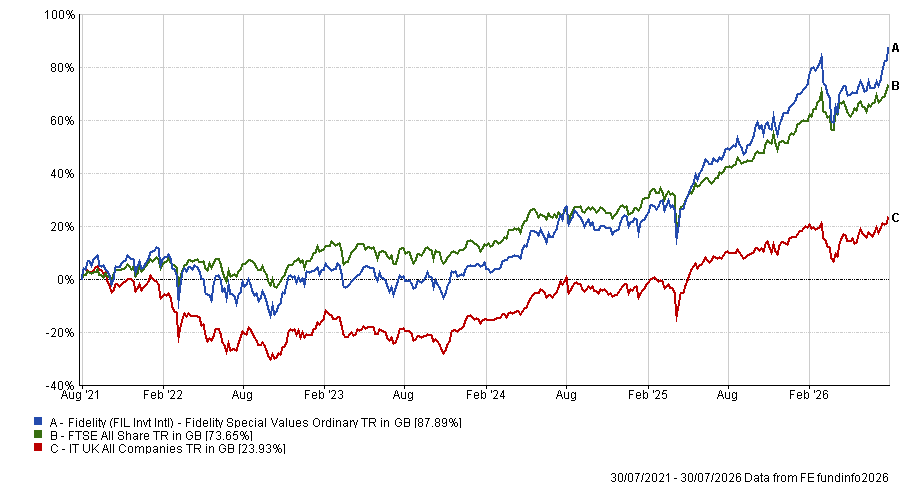
Source: FE Analytics
Bigley also suggested the Dodge & Cox Worldwide Global Stock.
Rather than purely screening for low valuation multiples, the management team – the firm’s global stock investment committee – targets established businesses which they believe have long-term earnings power and competitive strengths not yet fully reflected in their share prices.
“This often leads them to capitalise on periods of market uncertainty when quality companies become temporarily mispriced,” Bigley said.
The fund is currently overweighting financials and healthcare but does not completely neglect tech stocks.
“Geographically, the portfolio is also less reliant on the US market than most global funds, providing valuable diversification,” he added.
“The differentiated sector and regional positioning can help diversify portfolios that are heavily concentrated in US mega-cap technology stocks, while providing exposure to attractively valued companies across global markets.”
A decade of share buybacks has quietly boosted US equity returns – but the oncoming wave of AI company IPOs could change that.
The AI initial public offering (IPO) boom may reverse a decade-long tailwind for US equity returns – and emerging markets could stand to benefit.
This is according to recent research published by Ninety One, which mapped different scenarios for how the current wave of AI company public listings – led by SpaceX and expected to soon be followed by OpenAI and Anthropic – could affect US equity returns over the next 10 years.
For the decade ending in 2025, US companies bought back so much of their own stock that shares became scarce and that scarcity pushed prices up, explained Sahil Mahtani, director of Ninety One’s Investment Institute, and Daniel Morgan, an analyst within the firm’s multi-asset team.
The buyback tailwind added around 0.7% a year to returns, according to their analysis.
But with big AI players going public – and established tech giants like Alphabet and Oracle also raising funds across both equity and debt markets to fund the AI build-out – the market could see this reversing, as new share issuance floods the market instead, diluting returns unless earnings grow fast enough to keep pace.
This could become a headwind for the US equity market, which has just had one of its strongest three-year runs in modern history.
How the 2023-2026 US equity rally compares to previous years
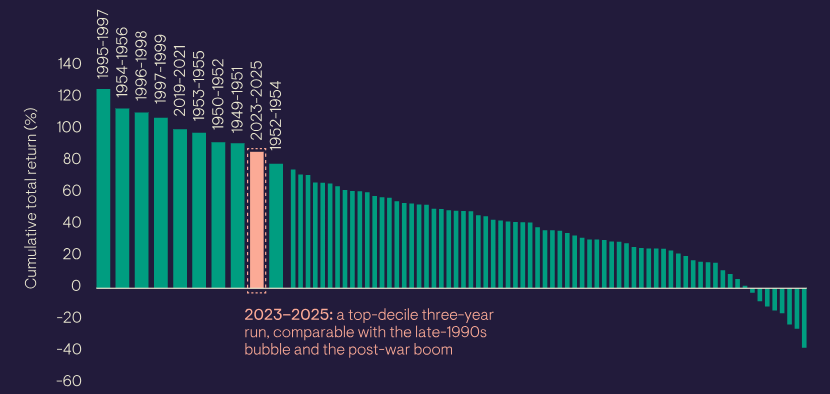
Source: Ninety One, Bloomberg, S&P
This wave of AI company public listings will not, on its own, end the bull market in the short-term, Mahtani and Morgan maintained.
“SpaceX, OpenAI and Anthropic raising $200bn-$250bn at listing is around 0.3% of an around $75trn market: real money, but not enough to move it,” they said.
The bigger risk lies further out. This is because companies typically only float a small slice of their shares at IPO, often around a quarter of the total. Within the first two years, Ninety One’s analysis suggests that share tends to grow to around 70%.
Applied to SpaceX, Anthropic and OpenAI, that could mean close to $4trn in additional shares reaching the market – a 4% expansion of US public equity.
“So the real question is what a sustained reversal of de-equitisation does to a decade of compounding,” Mahtani and Morgan said.
The research modelled three possible scenarios built using Ninety One’s Capital Markets Assumptions framework, which is based four components: income (the dividend yield the index pays today), growth (how much corporate earnings are expected to expand), revaluation (whether today’s valuations are likely to rise, fall or stay flat versus history) and market composition (the effect of shares entering or leaving the market).
As of April 2026, these four components combined to produce a 2.7% return over the next 10 years, according to the analysis.
In the base case, Mahtani and Morgan assumed recent trends continue as buybacks persist, the IPO wave is absorbed without major disruption and market composition adds 0.4% a year to returns, keeping the 10-year return assumption at 2.7%.
The second scenario assumes the past two decades of shrinking share count were an anomaly. Instead, it assumes a century average for market composition of -2.1%, which pulls the 10-year US returns down to 0.2%.
The third scenario assumes market composition mirrors levels last seen during the dot-com bubble, when it detracted around 4.5% a year from returns. Under this scenario, Mahtani and Morgan suggested 10-year US returns could fall to around a 2.2% loss.
US equities 10-year expected return under Ninety One’s three market composition scenarios
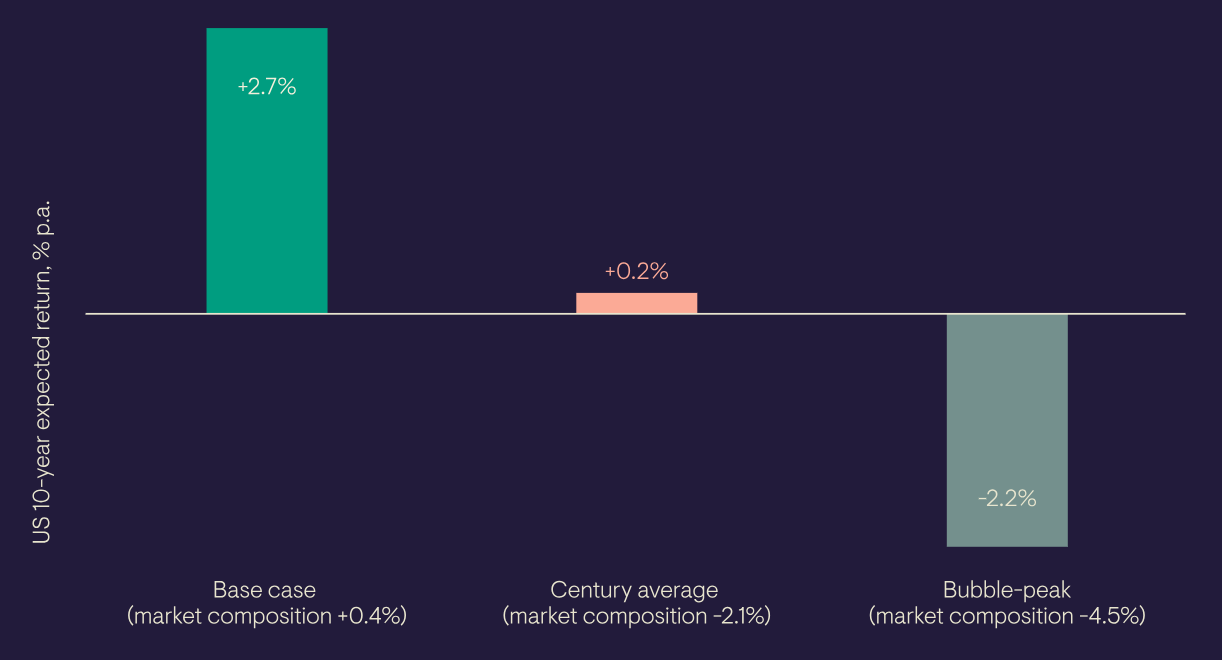
Source: Ninety One Capital Market Assumptions
However, a potential ‘overhang’ could arrive before 2027, according to the research, due to two features.
The first is that index providers are loosening their own rules to admit these big AI names more quickly into their products. Nasdaq implemented rule changes that allowed SpaceX to join the Nasdaq 100 index just 15 trading days after its IPO, with relaxed float and market cap requirements.
The second is that some of these deals are being structured to grow the tradeable float more quickly than usual.
“SpaceX, for one, replaced the standard 180-day lock-up with a staggered schedule of releases,” Mahtani and Morgan said.
“Index inclusion obliges passive funds to buy at whatever weight the float dictates, and a rising float means rising forced demand.”
Whatever scenario is the one to play out, Mahtani and Morgan said the de-equitisation (shrinking share count) that underwrote the bull market is ending.
“Over the next ten years, US equity returns are going to have to come from elsewhere,” they said.
The two experts pointed out that the same mechanism now threatening US returns has already played out in emerging markets – particularly China – over the past decade.
“In the 2010s, index investors were obliged to absorb a decade of dilutive inclusions, much of it Chinese and often at cyclical valuation peaks: stocks entering MSCI China were typically added at a premium averaging close to 78% in the years after 2011, up from around 15% before then,” they said.
Market composition drag in China, 2010-2024
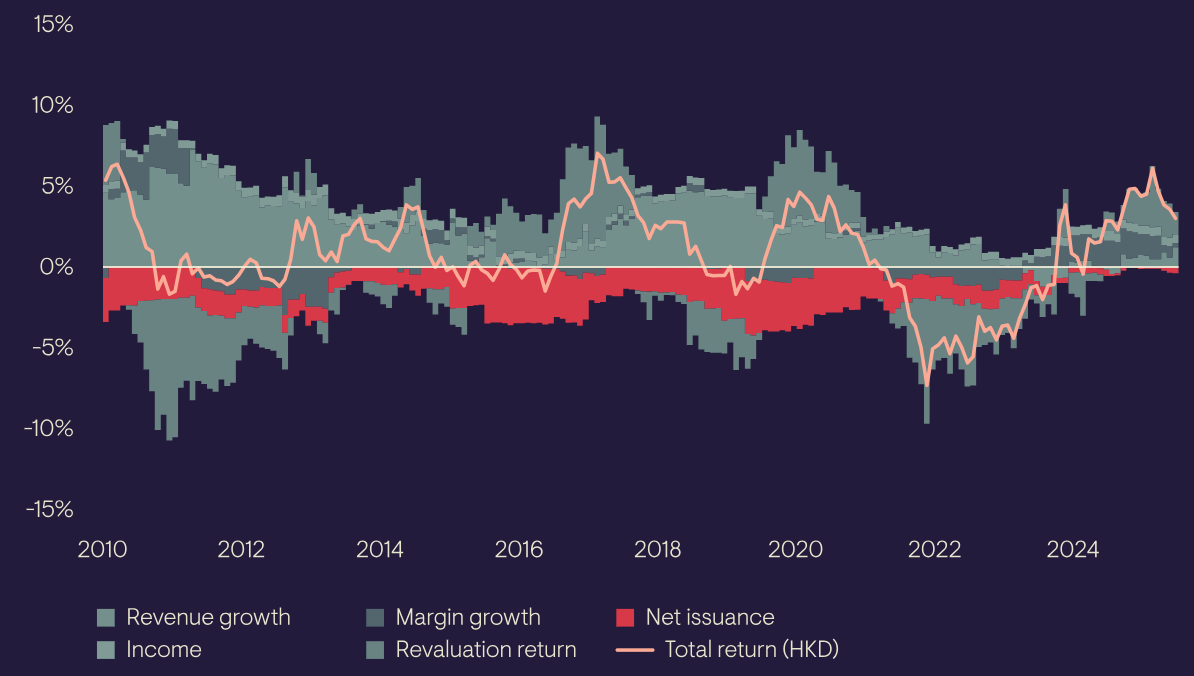
Source: Ninety One, Bloomberg
This market composition drag that held emerging markets back during that time is now fading, Mahtani and Morgan argued, noting that this could mean the region is an attractive alternative for investors over the next 10 years.
A stark recent change of direction in the country has been both very welcome and very significant.
For much of the period since the global financial crisis, corporate Europe has struggled to keep pace with the US. Economic growth has been weaker, investment has been lower and European stock markets have lacked meaningful exposure to the technology giants that have played such an outsized role in driving global equity returns.
Germany, once regarded as Europe’s industrial engine, has come to exemplify the problem. The country has endured years of stagnation as higher energy costs, weak export demand, ageing infrastructure and growing competition from China have weighed on its manufacturing-led economy. Indeed, the country endured two consecutive years of recession as recently as 2023 and 2024.
Moreover, a widespread allergy to government debt – even to fund desperately-needed investment in railways, roads, electricity networks and digital infrastructure – was codified by the Schuldenbremse, or debt brake, limiting annual structural federal net borrowing to a paltry 0.35% of GDP.
Therefore, a stark recent change of direction in the country has been both very welcome and very significant. Chancellor Friedrich Merz’s government has loosened Germany’s constitutional borrowing restrictions, creating a multi-year commitment through a €500bn infrastructure fund, the Special Fund for Infrastructure and Climate Neutrality.
As recently as early July, the ruling coalition finalised a 34-point ‘programme for growth and employment’, covering everything from cutting red tape for business to raising the bar for employees taking sick days.
Then there is the step-change in defence spending, specifically Germany’s decision to exempt much of it from the debt brake, coupled with a target of spending 3.1% of GDP on defence by 2027 and 3.7% by 2030.
This is at a time of severe doubts over the reliability of US support for Europe, even with the looming threat from Russia. The moment that crystallised this risk for Germans was the Russian invasion of Ukraine in 2022, which led directly to the Zeitenwende, or epochal change.
This was a paradigm shift announced by Merz’s predecessor Olaf Scholz, overhauling Germany’s post-World War II security strategy and permanently altering its relationship with Russia. The return of Donald Trump to the White House only served to further entrench this need for change.
Much of the immediate impact of these changes will be felt in the corporate sector. Specifically, construction groups, engineering companies, defence contractors and businesses supplying technology for transport and power infrastructure should all benefit from increased demand.
In addition, better infrastructure across the country could reduce costs over the long term, improving productivity and giving private companies greater confidence to invest.
An opportunity for European smaller companies
The potential beneficiaries are not confined to Germany’s largest businesses. Smaller European companies are often more closely exposed to domestic investment, construction and manufacturing supply chains than the continent’s multinational giants.
They may therefore benefit disproportionately if public spending encourages businesses to increase their own capital expenditure.
This opportunity extends across the IT European Smaller Companies investment trust sector. European Smaller Companies Trust (ESCT), for example, currently has 23% of its portfolio in Germany and almost 30% in industrial companies. JPMorgan European Discovery (JEDT) has less direct German exposure, at around 9%, but industrials account for approximately a third of the portfolio.
Montanaro European Smaller Companies
Within this peer group, Montanaro European Smaller Companies offers a more concentrated quality-growth approach, with particular exposure to specialist industrial and technology companies.
The trust has never been a direct bet on the German economy, but its portfolio contains many of the specialist industrial and technology businesses that stand to benefit.
Its manager George Cooke focuses on high-quality growth companies operating in often niche markets. Industrials (31% of the total as at 30 June 2026) and technology (29%) account for a significant share of the portfolio.
Holdings such as Carel Industries (3.8% of the portfolio) and Belimo (4%), for example, provide systems used to improve the efficiency of heating, ventilation and air-conditioning equipment. Investment in upgrading commercial premises, hospitals and other buildings could support demand for their products over time.
When it comes to defence, Montanaro European Smaller Companies does not own the large weapons manufacturers that have already enjoyed substantial share-price gains. Its exposure is instead concentrated among specialist suppliers.
Invisio (2.5% of the portfolio) produces communication and hearing-protection systems for military and public-safety customers, while Kitron (4.6%) manufactures electronic components for defence, aerospace, industrial and medical companies.
This indirect exposure should prove beneficial to MTE as the knock-on effects of increased defence spending spread through supply chains.
Germany is only the trust’s third-largest country exposure, at 17% of the total. However, European industrial supply chains are highly integrated, meaning a revival in German capital expenditure could also benefit specialist suppliers listed elsewhere on the continent.
The shift by Europe’s largest economy may also give other governments greater political cover to increase their own investment, widening the potential opportunity beyond Germany itself.
There are risks
Such big changes inevitably also bring risks. Clearly, approving large sums of money is much easier than deploying them productively, and Germany’s planning rules, procurement systems and bureaucracy have repeatedly delayed major infrastructure projects in the past.
There is also the risk that investors expect too much, too soon. Infrastructure projects can take years to approve and complete, while defence companies and some industrial stocks have already rerated sharply. Higher government borrowing could also push up bond yields, partially offsetting the benefit for growth companies whose valuations are sensitive to interest rates.
Most importantly, additional spending will not resolve all of Europe’s structural disadvantages. Germany and other European countries still face ageing populations, high energy costs, and in many cases excessive regulation, often at an EU-level.
Indeed, partly as a result of a cautious approach to emerging technologies, Europe remains far behind the US and China in artificial intelligence and mega-cap technology, which may hold its corporate champions back, and continue to weigh on relative equity-market performance.
But change is unquestionably welcome
Yet Europe does not need to recreate Silicon Valley for the spending reset to make a difference. The region retains considerable strengths in advanced manufacturing, semiconductor equipment and elsewhere – precisely the areas that should benefit from a sustained recovery in public and private investment.
Therefore, Germany’s fiscal reset should be seen as an important step rather than a complete solution. It cannot immediately reverse years of underinvestment or close Europe’s technology gap with the US. Nor will every euro of spending translate neatly into higher profits.
Nevertheless, what Germany’s spending reset clearly does is create a more supportive backdrop for corporate Europe than the austerity-led model it replaces. For investors willing to look beyond the region’s largest companies, it could provide the catalyst for a long-awaited improvement in investment, productivity and business confidence.
Montanaro European Smaller Companies appears well placed to participate in that improvement – although the benefits are likely to mainly be indirect and will depend on how effectively the new spending is deployed.
David Batchelor is senior fund analyst at QuotedData. The views expressed above should not be taken as investment advice.
Eyes turn to the looming lock-up expiry, mounting AI spend and Musk’s ambitions.
SpaceX has issued its first earnings report since its initial public offering (IPO), announcing a 92% jump in revenue to $7.8bn in the three months to June.
Of this revenue, $962m came from the space portion of the business, $4.3bn from connectivity and $2.6bn from AI.
The company remains not profitable, reporting a loss of $541m – down from a $1bn loss in the same quarter last year. SpaceX lost just shy of $5bn in 2025.
This follows a blockbuster IPO in June, which transformed it into a $2trn company and crowned founder Elon Musk as the world’s first trillionaire.
But the path has not run smooth, with the company’s stock falling around 25% by early July. On 4 August, SpaceX closed trading at $125 a share, down from its IPO price of $135 a share.
While market experts agree the quarter’s earnings report is largely positive, the longer-term trajectory of the company is still up for debate.
Matt Britzman, senior equity analyst at Hargreaves Lansdown, welcomed the strong quarterly results but noted that, at such an early stage in its public life, “beating consensus carries little real weight”.
The company is also rapidly evolving, with analysts still trying to work out what the business really is, as Musk outlines some of his big goals over the next decade.
SpaceX is currently composed of its core aerospace operations, the Starlink satellite internet division and AI platform xAI, each promising ambitious developments over the next 10 years.
For example, next month, Musk has announced the company will launch its next Starship flight test, in which it aims to send its first upgraded Starlink satellites into orbit and return the rocket system’s upper stage to land for the first time.
“Starship and the next generations of Starlink remain critical to the post-2030 vision, but the financial engine over the next few years will increasingly be AI,” Britzman said, noting that “Musk has effectively gone all-in on building AI infrastructure”.
SpaceX spent more than $10bn on AI infrastructure in the first quarter of this year. In the second, it invested another $18.4bn. It said AI revenues grew 247% year-over-year.
“While demand remains high and SpaceX can bring clusters online faster than rivals, that looks like a compelling way to turn speed and access to hardware into revenue,” Britzman said.
“So long as demand for intelligence continues to ramp (and it’s hard for us to see that trend shifting) rental contracts should keep growing as more capacity comes online. SpaceX could soon resemble an AI infrastructure company with an extraordinary space business attached, and that is not an unattractive combination.”
The results were “encouraging” for Garry White, chief investment commentator at Raymond James. However, he noted, potentially choppy waters lie ahead as SpaceX will be issuing over 900 million shares on Thursday 6 August – more than double the current amount available.
Those who acquired shares in the space and AI company before its public listing did so at a fraction of the price, so they stand to make big gains should they sell when the share lock-up expires. But these sales could then pile pressure on the stock price.
“While an unlock does not necessarily mean there will be a flood of selling from insiders, the prospect of a substantial increase in supply will act as an overhang and could weigh on the share price in the near term,” White said.
“Conversely, if insider selling proves limited, this could be interpreted as a vote of confidence in the company's longer-term prospects, providing a prop for the share price.”
But not everyone felt encouraged.
Russ Mould, investment director at AJ Bell, said: “As visual metaphors go, the fact a SpaceX rocket crashed into the moon hours after it had delivered its debut quarterly earnings feels almost too on the nose.”
He said the concern isn’t around the numbers themselves, as revenue did beat expectations and losses were narrower than anticipated, but around the heavy AI spending revealed in the results.
“This is something the market has taken exception to at many of SpaceX’s peers and the scale of the outlays on AI and how much over and above they were on analysts’ expectations were key factors behind the backlash,” Mould said.
“A significant difference between SpaceX and some of the other free spending participants in the AI arms race is that it does not yet generate meaningful levels of cash flow.”
Despite this level of spending, Mould pointed out that, right now, it is SpaceX’s Starlink that generates the bulk of the company’s revenue, with Musk hinting that Starlink could next build a terrestrial mobile network to compete with T-Mobile, AT&T and Verizon.
“This has sparked some nervousness and seen these established names take a bit of a share price hit,” he noted.
“Though Musk has lots of things on his to-do list at SpaceX, so there may be hopes in the boardrooms of these businesses that other areas take priority.”
His to-do list includes the lofty ambition of colonising Mars, as well as building lunar bases and data centres in space.
“Questions are also likely to persist about a tie-up with Tesla, something Musk and other SpaceX executives didn’t rule out,” Mould added.
“For many investors in both SpaceX and Tesla, their interest is linked to Musk’s entrepreneurship, so bringing his entire empire under one roof is an idea which may continue to get plenty of airtime.”

The information contained within this website is provided by Allfunds Digital, S.L.U. acting through its business division Digital Look Ltd unless otherwise stated. The information is not intended to be advice or a recommendation to buy, sell or hold any of the shares, companies or investment vehicles mentioned, nor is it information meant to be a research recommendation. This is a solution powered by Allfunds Digital, S.L.U. acting through its business division Digital Look Ltd incorporating their prices, data news, charts, fundamentals and investor tools on this site. Terms and conditions apply. Prices and trades are provided by Allfunds Digital, S.L.U. acting through its business division Digital Look Ltd and are delayed by at least 15 minutes.
© 2026 Refinitiv, an LSEG business. All rights reserved.
 Please wait...
Barclays Investment Solutions Limited provides wealth and investment products and services (including the Smart Investor investment services) and is authorised and regulated by the Financial Conduct Authority and is a member of the London Stock Exchange and NEX. Registered in England. Registered No. 2752982. Registered Office: 1 Churchill Place, London E14 5HP.
Barclays Bank UK PLC provides banking services to its customers and is authorised by the Prudential Regulation Authority and regulated by the Financial Conduct Authority and the Prudential Regulation Authority (Financial Services Register No. 759676). Registered in England. Registered No. 9740322. Registered Office: 1 Churchill Place, London E14 5HP.

